What a nice tour. Great ideas for my daughter, who teaches kindergarten at a Lutheran School in Grand Rapids. She was inspired. We enjoyed wonderful fellowship afterwards as well at Jennie’s home. My only regret was not being able to stay and walk around. Another time maybe. Jennie you certainly are an outstanding host. Your sweet corn was the best I’ve ever had. Loved your coleslaw too (and I’m not the only one from the comments). Thank you for giving us such a great lesson at the gardens and your entire family for hosting a great feast from your bounty afterwards.

Thank you Naida and Chris for your hard work yesterday morning. The beds look great! I’m shocked at how much we accomplished. I finished the Island bed and the one by the bench last night. Just have a few to pull under the Weeping Willow tree. I’ll take care of that in the next few days. How rewarding it was when I left yesterday morning to see a family at the picnic table (gingham table-cloth and all) under the Willow preparing for a picnic lunch. Again last evening folks were enjoying that same table, without the branches in their faces. That made it all worth it. It was nice to have community members thank us for what we were doing. I’m happy it is so appreciated.
Posted in Uncategorized | 6 Comments »
So soon a complete article will be written and will show the completed Sundial Project at Veterans Park. All credit to those involved will be given at that time. But we thought it might be nice to just post a few shots of the location and some of the progress. If you’re in the area, stop by, it’s almost complete. They were setting the hour stones this past Saturday.







We really need to work on the Childrens Sensory Garden beds. They are overgrown with weeds. I’m working on them a bit at a time. However, I need some volunteers to help me out. Once they are done, it’ll be much easier to keep up. With the hot weather , morning has been my choice of time. This week we are to get cooler weather. With group of volunteers we could get them done in no time. How would This Thursday be for some of you? (Aug. 11) Let me know if you can help. I’ll be there both in the morning for a few hours and again Thursday evening about 6:00pm for a few hours. It would be nice if we had a group there for photos working on this community project.
Posted in Community Projects | 5 Comments »
 This insect has an uncommon genetic mutation which results in its bright pink color. It is found in our area during this time of year. Name the mystery bug. Bonus if you can name the mutation! Post your response as a comment. Winner gets bragging rights!
Posted in Mystery Bug, Uncategorized | 7 Comments »

I confess, I love using every odd container that doesn’t look like a clay pot for my garden containers. As many of you know, I obsess about food and my “batterie de cuisine” is proof. Canners, roasters, skillets, colanders, wicker food gift baskets from Harry and David, galvanized wash tubs and yes, a fish poacher (I have 4) are put into service to hold my annuals and cherry tomatoes. The list can be endless. Just remember, the container needs good drainage, my power drill takes care of that. If I don’t like the color, spray paint is my best friend.
Perennials shrubs and small trees can also be potted in a container, but I am programmed to plant those in the ground. Fall is busy enough with removing annuals from the ground, planting next spring’s bulbs and raking, so just thinking about replanting a potted blueberry shrub in the ground gives me vapors.
Since this article really isn’t about me but planning great containers, a few reminders on how, what and where need to be mentioned. It might be a tad late for this year’s showcase but as gardeners’ say, “wait until you see my gardens next year”.
Planting Techniques
To improve aeration and to add weight to the container, line the bottom with pebbles, broken pottery or a few rocks. If the container is large and if weight is the problem, fill discarded onion or potato sacks with the plastic peanuts for bulk (thanks, Jennie).
Container Media
Prepared soil-less mixes are preferred for containers. The basic components of these mixes are organic matter and perlite, vermiculite or sand. Standard mixes are free of disease organisms, weed seeds and insects. (I can supply those all myself). A common proportion is 2 parts organic matter to 1 part perlite, vermiculite or sand. I add additional organic matter from my compost bins. Add a slow-released granular or powdered fertilizer to the soil-less mix. Nutrients are washed away much faster in a container than a plant in the ground.
Planting
Fill your container half full with potting mix. Moisten the potting mix; it should be damp not wet. Remove the plant from its original container, loosen its roots and stand the plant in the soil. Fill the pot with more soil, making sure to get rid of any large air spaces in the soil. The root ball should be level with the surface of the potting soil. Leave some space between the top of the soil and the top of the container so water and soil will not run out of the top.
Two common mistakes are underpotting and overpotting. A good rule of thumb is that the root ball of the plant, when in a pot, should have about 1 inch of soil around it. Water the plant thoroughly.
Watering and Fertilizing
As mentioned previously, most containers, including hanging baskets, will need daily watering. If the top layer feels dry to the touch, water that container until water runs through the drainage holes. Apply a water soluble or liquid fertilizer every few weeks once the plants are established.
Now comes the fun part-plant selection
Or maybe the most stressful

See the big picture when combining plants. We are all familiar with the “spillers, fillers and thrillers concept. The best way to assemble a winning container combination is not to be shy about mixing and matching plants at the garden center. Walk around with your plants and stand back when pondering a possibility. Don’t be too swayed with flowers already in bloom, they come and go; we live with SHADE so foliage is my place to start. Plants with interesting leaves can bring structure, texture and color to a design. Focus on a plant that catches your eye and match it to other plants. Choosing a blend of glossy, matte or fuzzy leaves adds another level of interest. Look for color compatibility, paying attention to intensity among those plants. This doesn’t mean that having a bold contrast in that mix won’t work, it can.
Don’t forget, when you do choose plants, consider your site and the plant requirements.
Late-Season Gardening
If Peter Rabbit or Japanese Beetles have wreaked havoc on your container, don’t despair, drive to the garden store and buy a few new replacement plants. August is the time for bargains and mums. A perfect time to try a few new combinations, besides, I have 3 more fish poachers to fill.

Patio Garden-small spaces, Frank’s Nursery and Crafts
Designing Great Containers, Fine Gardening May 2009
Office of Public Programs, U.S. Botanic Garden July 1991
Georgeann Brown
1992 Master Gardener Class
Posted in Garden Showcase | 2 Comments »
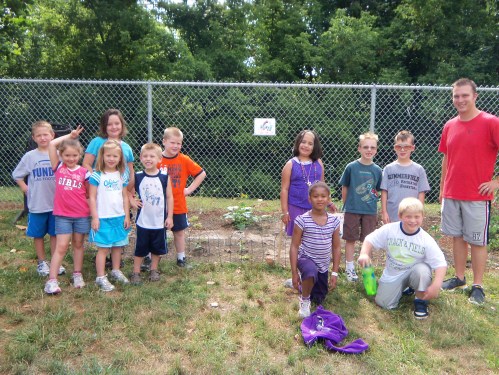
Gardening group at the Monroe YMCA
I am wondering what kind of outreach programs or activities other Master Gardeners are involved in. I would like to share a modest, small project I am involved with at the Monroe YMCA. Betsy Bradley approached me about maintaining a small vegetable plot with one of the children’s day care groups. Apparently someone started a native plants bed and vegetable garden last year, but then moved out of town. I checked with Jennie to see if I could receive credit for this type of outreach and she agreed. We did not plant until the third week of June, but the children planted zucchini, cucumbers, and zinnia from seed and also planted peppers, tomatoes, and basil plants. We have had a lesson on companion planting and planted some alyssum with the tomatoes. There is a rain gauge to remind the children to water the plants. So far, everything is growing. We hope to make pizzas with the tomatoes, zucchini, peppers and basil.
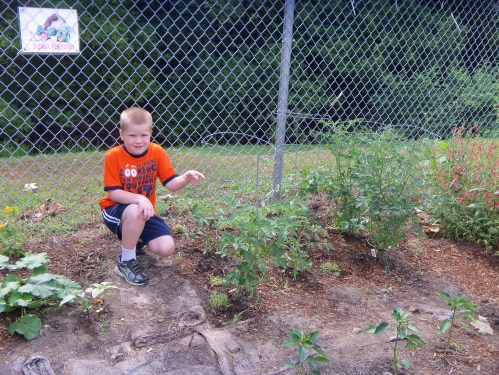
YMCA young gardener and his tomato plant
Posted in Community Projects | 4 Comments »
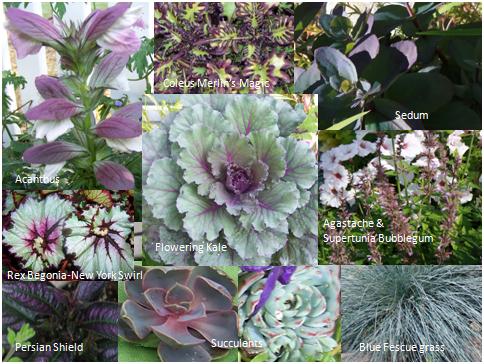
Here’s a tip on color combinations. I use photos as a tool for containers or planting areas. You can of course do a “like” or “Contrasting” combination. I take photos all the time in my garden. I save copies and crop some of the plants. It’s best to add the name of the plant as soon as possible. I know I forget what they are sometimes. I then go through the cropped photos and put them together in a collage. Some plants may be able to be divided, others are annuals that I’ll purchase again next year or save. Of course it’s important to know the Sun/Shade requirement. All but one of these plants can take sun or partial shade. The one that needs full shade is the Rex Begonia. I probably will plant that into a separate container so I can make sure it’s shaded. Also that allows me to bring that in the house come Fall. Water consideration also are important.
The best part is that it’s a “Free” way to experiment. No up front costs. You can use photos from gardens you visited, botanical gardens or even internet photos. Then print it out and take it with you to the nursery. No need to buy extras you won’t need. Hope this helps you in your planning.
Do you have a favorite planning method?


Posted in Garden Showcase | 4 Comments »
 When one is spending a long holiday weekend spreading a mulch pile big enough to be seen on Google Earth (no exaggeration!), one has time to ponder stuff. All summer I’ve been looking at some gross looking stuff on the mulch pile and in my beds. I’d been throwing it whole into a brush pile in our woods, but I couldn’t keep up with it. I did some research and – lo and behold! – it is slime mold. Probably most of you are very familiar with it, but I’m a newbie at this gardening thing and it was new to me. Here’s what I learned: slime molds aren’t really molds at all. Molds are fungi. Fungi are included in the Plant Kingdom. Slime molds are included in the Kingdom Protista. When did we get a new taxonomy kingdom? Last I knew (Biology II, 1974) there were only two. Kingdom Protista is the “not animal, not plant, kinda weird, everything else” kingdom, and includes single-celled life forms such as protozoa, amoebas, and other organisms, including slime molds. The cool thing is slime molds can move! Slime molds such as Physarum polycephalum are actually just one enormous cell with millions of nuclei. This giant cell has locomotion, but you’d need time-lapse photography to see it. Slime molds are most prevalent during wet seasons (like this spring), and feed on bacteria and fungal spores found in mulch and turf. They start out looking like something the cat yakked up, kind of clear and slimy, but over a short time they solidify, becoming yellow, pink, or some other weird color. Over time they turn tan or brownish as they dry out. They’re not harmful, but if their looks bother you, just scoop them up whole and pitch them out of your garden. You can’t really get rid of them, though, so why bother? I found these organisms really intriguing when I read about them. If you want to read more, here’s a cool article I found and used for this blog: http://herbarium.usu.edu/fungi/FunFacts/slimemold.htm .
 As I was finally seeing the light at the end of the tunnel on the mulch, I remembered an inservice education I had last year at the hospital where I work, about Composter’s Lung. (Well, actually it was billed Hot Tub Lung, because that sounded more exciting, but it’s pretty much the same thing. When I saw the organisms involved, with my new MG knowledge fresh in my mind, I said, “those are compost organisms!” The pulmonologist said, “yes, it is also called Composter’s Lung, if that’s how the person actually got the illness. But I digress.) Composter’s Lung is actually a hypersensitivity pneumonitis, a severe reaction caused by an intense exposure to small particles of biologic material. Organisms in compost and mulch that can cause illness include thermophilic actinomycetes, including Aspergillus species. A person breathes the in the offending organism which causes an allergic response, similar to hay fever or asthma. Repeat exposures cause the hypersensitivity response, which is often confused for other lung illnesses, and occasionally can be quite serious. People who tend to have allergies or sensitivities are most likely to be affected. It takes pretty large exposures, often over extended periods of time, to affect people. The incidence of illness is extremely low, considering how many people spread mulch and compost, so this isn’t something I’d lose sleep worrying about. However, it might not be a bad idea to use a mask if you’re working with mulch, compost, or damp or moldy straw. If you’re interested in reading more, there are all kinds of articles available on the internet. Here’s the one I used for this blog: http://www.emlab.com/s/sampling/env-report-01-2006.html . Photo credit – No. 14 from Soil Microbiology and Biochemistry Slide Set. 1976. J.P. Martin, et al., eds. SSSA, Madison, WI
Rats, I spent all my time writing about gross stuff and forgot to take a few quick photos of how nice my beds look, what with all the new mulch and all. Tomorrow….
Posted in Uncategorized | 2 Comments »
After long discussion, my husband convinced me to have him add two of these in his vegetable garden. Much to my surprise they are doing quite well.

Posted in Vegetables | 1 Comment »
article forwarded from Jennie Stanger.
Master Gardener volunteers from Genesee, Kalamazoo, Kent, Livingston, Oakland and Washtenaw counties are now offering a statewide service to answer consumer horticulture questions. Residents throughout the state can get answers to questions from a consumer horticulture experts concerning vegetable and flower gardening; lawns, shrubs and trees; indoor plants; and garden and house pests through the MSUE Lawn and Garden Hotline.
A team of horticulture educators developed the state garden hotline. The team was led by Bob Bricault and included Rebecca Finneran, Terry McLean, Gretchen Voyle, Linda Whitlock and Mary Wilson, who will continue to provide support to the hotline and Master Gardener volunteers.
The MSUE Lawn and Garden Hotline uses the same toll-free number that people use to reach county offices: 1-888-MSUE-4MI (1-888-678-3464). When calling the number you will be asked to press “1” to be connected to the hotline. It is answered weekdays between 9 a.m. and noon and 1 and 4 p.m. Local residents are encouraged to use the hotline as Monroe County no longer has a staff person in place to answer these types of questions. As budget cuts have caused down-sizing in positions there has been an increased need to better utilize technology and have statewide resources made available to address the educational needs of residents. The new hotline will provide ongoing service to address consumer horticulture questions
Posted in Uncategorized | 2 Comments »
 Monroe County Master Gardener Association