Feeds:
Posts
Comments

Tomato Problem?

Here’s a great tool offered from the Texas AgriLife Extension Service, Texas A&M System.  This is a great pictorial tool for tomato problems.  Just click on the link (or copy and past).

http://aggie-horticulture.tamu.edu/publications/tomatoproblemsolver/

The website also has a guide for cucurbit problems.  I suggest you browse the site for other sources of information.


This week, we have some lovely photos Georgeann took during her vacation. I can almost feel what this morning was like! Georgeann writes, “A foggy day in London town? No,  just a view from our pop-up camper in Norris Dam State Park south of Knoxville TN.”

Linda documented the outstanding color of her hibiscus growing along with Clematis and Mandevilla.

My bluebird box has an interesting inhabitant. I noticed him shortly after the second clutch of baby bluebirds fledged. He’s been there ever since.

1  Children’s Garden 1 – In the Fall of 2005 when Jennie asked me to help her with the “Children’s Orchard,” I said “Sure, where is it?” She led me to that awful place along the field edge behind the storage area and the disposal tanks. After completing some much-needed clean-up, Jennie asked me if I would consider renovating the garden.  I worked on the design that Winter and with the help of a man and his truck (my husband Calvin) installed the 3 initial hardscape elements that would define the tiny space.
2  Children’s Garden 2 – Stella Kirby popped by the new “Children’s Garden” one evening in May of 2006 and helped me plant the 11 White Chiffon Rose of Sharon.  As the small garden grew, Stella continued to help in the garden and she and I became good friends.
3  Children’s Garden 3 – At the end of the first year, the little garden was taking shape.  The Rose of Sharon bloomed into September and the Hyacinth runner beans made a spectacular show covering the re-bar tunnel.
4  Children’s Garden 4 – In 2007 hundreds of marigolds and sunflowers filled the garden.  Several Master Gardeners started 10 varieties of dwarf sunflowers for the garden – small enough for smallest of garden visitors to enjoy.  Jennie suggested expanding the little garden along the field edge.
5  Children’s Garden 5 – By November 2007, with the help of many Master Gardeners’ hands, the expansion was completed.  A new path and a stone bridge were installed.
6  Children’s Garden 6 – Year three was an explosion of annual color.  The thymes were taking hold, softening the edges of the paths and giving off wonderful fragrances.
7  Children’s Garden 7 – Fall clean-up left the garden a blank canvas again for me to contemplate the next growing season during the winter months.
8  Children’s Garden 8 – Stella painted the rock turtles that dot the dry creek bed and hide in the thymes, adding more whimsy to the little garden.
9  Children’s Garden 9 – The garden continues to grow and mature.  The Blue Muffin Viburnum flowered profusely, but failed to hold the much-anticipated blue berries that the birds would have enjoyed.
10  Children’s Garden 10 – The Rose of Sharon, blooming from June through September, are the stars of the garden every year.  The garden hosts many visitors, including my Mom who instilled in me a love of gardening, and my youngest granddaughter, Zoe, who helped me plant annuals this year in the garden.
This little garden has been a joy to me and I hope to all who have visited there.  It would not be as special a place had it not been for all of the wonderful Master Gardeners who have helped each year along the way.   Thank you to all who have contributed to my learning process.  The Children’s Garden has been a true “Work n’ Learn” project for me for the past six years. 

After attending a program on small fruit given by Jennie Stanger at Monroe Extension several years ago I decided to set aside part of my garden and dedicate it to a couple of rows of strawberries and a row of raspberries.  It was one of the best decisions I ever made!  My love affair with raspberries started with the purchase of 25 (5 plants minimum order) plants from Nourse Farms in 2009, with the variety Caroline (an improved Heritage) being my choice.  Nourse is a great supplier and they have a very informative and colorful website which takes much of the guess out of choosing a variety, planting, harvesting and caring for your plants.

The first spring of planting those wooden looking sticks in the ground it didn’t look very promising.  As that year progressed new plants started appearing in the rows between the “sticks” and by fall I even picked a few handfuls of raspberries.  The next year the row had pretty much filled in and I was in business.  The photos are of 3 years after planting – one 30′ row of about 18 plants (I shared extras) gives me all the raspberries I could want.  So far this year I have made 3 batches of jam, 8 pies and shared with my daughter and her family for smoothies and cereal.  I am picking about 5 quarts every other day and the season is only about half over.

I hope by sharing my story and seeing these photos you will be encouraged to try dedicating an area for raspberries.

Tomato Time

Since tomato canning time is upon us, (well, getting late now) I wanted to share a story about canning tomato catsup (not ketchup! For some reason this is important to the story!) Over 40 years ago my former mother-in-law toured a Heinz factory with her Farm Bureau group, where they were shown the process for making catsup. There, a Heinz employee gave her a recipe for making catsup at home. Doris was never sure if the recipe was just one the woman knew, a “contraband” recipe she shouldn’t have given out, or a recipe Heinz gave to staff. At any rate, it was never a “public” recipe. She was very proud of that recipe, but I would never taste it because it “didn’t look right” to me. In other words, if it wasn’t the homogenous, syrupy stuff I grew up with, I didn’t want any part of it. After several years, I finally gave it a try. OH MY GOODNESS! It was fantastic!

After I grew older and began understanding the value in learning about cooking traditions, I yearned to try that recipe. I was worried – my former mother-in-law has dementia and I was afraid I’d lost the opportunity to get the recipe, if for nothing else but to pass on to my daughters. After searching awhile, my girls’ dad found the recipe. Doris was able to give me detailed instructions – and this year for the first time I made home-made catsup! I got my tomatoes from Charter Farm Produce on Ida Center Road. Here’s the recipe in Doris Ryan’s own words:

Doris Ryan’s Ketchup Recipe
Makes 5 quarts:

Day 1:

Cook .5 “heaped over” bushel of PEELED very ripe tomatoes (Doris advises no Roma tomatoes), 4 large sweet onions (Doris uses Spanish sweet or Vidalia), 4 large green bell peppers, and 6-8 banana peppers, until soft. You will know veggies are soft enough when the tomato “rinds” start coming out. Cook so as to have a nice steady boil.

Once soft, run mixture through a food mill for juice. Doris advises that your arm will get VERY tired but “you can’t hurry”. Let stand overnight.

Day 2:

Overnight the water and pulp will separate – take time to ladle out all the water you can get from the top. The more water you get out the better and easier it will be. Then, put juice and pulp in a large kettle and cook down to consistency you want. Doris advises 4-ish hours. Keep stirring often “because it will scorch or run over”. While it’s cooking add:

4 cups white sugar
1 quart apple vinegar
6 Tablespoons Barrel salt  – * NOT Iodized

While waiting for the juice to reach consistency, put the following in a cheese cloth sack:

2 Tablespoons black pepper
2 Tablespoons dry mustard
2/3 teaspoons cloves (ground or whole)
2/3 teaspoons allspice

After about 4 hours or whenever the consistency is right, add the sack of ingredients to the juice in the kettle. Cook down until juice thickens, stirring often (Doris says at least 4 hours more). Stir the sack around often. Doris says you know its time to take the sack out “when it’s thick and it tastes good”.

Ladle into quart jars and can by cold pack method for 20 minutes.

We have lots of great submissions this week! Way to go – keep it up! The first is a group from Naida and here’s her comment about her photos. –  “The Fungus Among Us” – This huge “fairy ring” which was about 20′ in diameter appeared in our Milan yard May 2011.  The mushrooms were the size of large dinner plates and really beautiful.  They appeared – seemingly overnight and for a couple weeks.  We didn’t want to hit them with the mower and spread the spores so I dug them out thinking that if I was able to get all the stem and mushroom they wouldn’t come back.  Well, they kept coming and the last photo is what the ring looked like in August.  This ring has been showing up for several years but without the mushrooms.  Wonder what will happen next year?  I would just love for someone to tell me they were edible!

From Debi Beier –

I have a picture of my 18 months old labrador, Maizy.  She is “smelling” my Proven Winner petunias, or so it seems.  In reality she was trying to eat them!
From Linda Welch –
Here’s my Angel Trumpet that volunteered in my garden.  I found it peeking from under my shed.  Thought it was a weed at first and pulled it.  Then after recognizing the leaf, I just stuck it in a pot.  That was about a month ago…it’s now giving me a show. These were taken in the morning after a night’s rain.
From Karen Hehl –
All were taken August 23 in my garden. The first is a Soraya sunflower, the second is a Lemon Queen sunflower, and the third is a swallowtail butterfly on a zinnia.

Photo credit Sean McClellan The Independent Newspaper (734) 529-2688

Photo Credit Sean McClellan The Independent Newspaper (734) 529-2688

Deb (fellow MG) and Mark Chapman of Chapman Sheep Farm, along with Georgeann Brown (MG class ’92) grilled lamb kebabs/kabobs for all to sample at the Dundee Farmers’ Market on 8/27. Many were surprised by the delicious flavor of the marinated lean boneless leg of lamb chunks. A few market samplers were hesitant because of their remembrances of mutton (yikes!) but young American lamb is a tasty alternative to beef. The Chapman’s sell all cuts of lamb (frozen) at numerous farmers’ markets in our area. Their kebabs are already cut into cubes. If you need something special, call Chapman Sheep Farm, Deb’s e-mail address is in our membership list.

A quick marinade for kebabs (great for chops as well)

1 Tablespoon brown sugar

4 Tablespoons soy sauce

1 large garlic clove, minced

1 ½ teaspoon ground cumin

¾ teaspoon ground coriander

Pinch of cayenne

¼ t freshly ground black pepper

1 Tablespoon fresh lemon juice

¾ teaspoon orange zest

Olive oil for the grill

    1. ½ pounds boneless leg of lamb, cut into 1½ -2 inch cubes

In a large bowl, combine the brown sugar, soy sauce and garlic. Whisk in the spices, lemon juice and orange zest.

Toss the lamb cubes in the bowl with the marinade and marinate at room temperature for 30 minutes or in the refrigerator for 4-6 hours. Turn the meat several hours.

Heat the gas grill to medium-high. Lightly oil grill.

Skewer the lamb cubes, leaving about half-inch of space between each cube so they’ll cook all around. Grill turning the skewers to brown on all sides for a slight charring, until medium-rare, about 5-6 minutes. Remove from the grill, let rest for a few minutes and serve.
Serves 4

Roses

100_1437 100_1441 100_1442 100_1443 100_1446

I find my roses are doing extremely well right now. I didn’t expect this since we have had such hot weather. But they are giving me a spectacular show.  I just thought I’d share them.  Has anyone else found their roses blooming well?

Architecture On Loan

Many details you find in architecture and design are borrowed from plants.  The acanthus mollis L.- (Bear’s Breech) is one such plant.  I’ve always loved the Corinthian column, with its curving leaf details.  I’ve incorporated the column into my home and garden.  One can definitely see how the bloom and foliage are on loan to architecture for added interest in buildings, furniture, trims, and decorative items.  So the first time I saw one in the garden center, I had to have it!  That was about nine years ago.  It’s given me great pleasure ever since.   I’ve been able to divide it, since it sends out shoots through it’s rhizomes.    I’ve also purchased some other varieties.  Some years it’s abundant with bloom, other years it’s not very productive.  What I’m calling a bloom is actually a stem of tubular white to rose flowers surrounded by three purple bracts.   There is only one stem of bloom this year.  Perhaps the heat is to blame.  It usually appears in mid summer and last quite some time.  Either way, bloom or not,  it’s a very interesting plant having large leaves that add texture.  Do be careful though;  it has a spiny nature and hides a thorn.   As an added benefit, the blooms dry well for arrangements.  I’ve included it in my Tuscan garden since it is native to the Mediterranean region.

100_1671 100_1673 100_1676

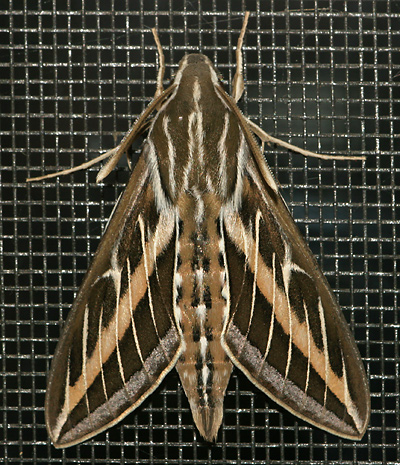
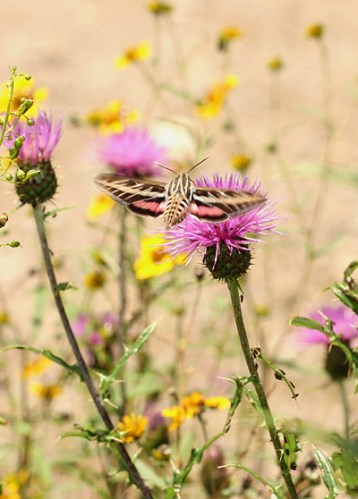
I emerge as soon as the sun set this time of the year, and can often be seen hovering before flowers as I sip nectar.  Occasionally I can be seen in daylight zooming around the garden, especially late in the season.  I am an amazing flier and have often been compared to a nocturnal hummingbird.

I am easily recognized by my large size, big eyes, furry brown thorax and six white stripes, tan band down each forewing with a row of white-lined veins across the forewings and by my pink and black hindwings.  Unlike my more svelt butterfly cousins…I have to beat my wings very fast just to stay aloft…a characteristic that enables me to hover in mid-air like a hummingbird.

Being a mainly nocturnal flier, I prefer white or other pale tubular flowers which are easier to see in the evening.  During daylight I can often be seen feeding at red or other brightly colored flowers…quite a contrast to my night-time color preferences.

The larvae of some of my more distant cousins can be quite destructive when emerging in your tomato or pepper patch.

Please post your answer as a comment.