Feeds:
Posts
Comments

Archive for the ‘Uncategorized’ Category

Here’s a great tool offered from the Texas AgriLife Extension Service, Texas A&M System.  This is a great pictorial tool for tomato problems.  Just click on the link (or copy and past).

http://aggie-horticulture.tamu.edu/publications/tomatoproblemsolver/

The website also has a guide for cucurbit problems.  I suggest you browse the site for other sources of information.


Read Full Post »

This week, we have some lovely photos Georgeann took during her vacation. I can almost feel what this morning was like! Georgeann writes, “A foggy day in London town? No,  just a view from our pop-up camper in Norris Dam State Park south of Knoxville TN.”

Linda documented the outstanding color of her hibiscus growing along with Clematis and Mandevilla.

My bluebird box has an interesting inhabitant. I noticed him shortly after the second clutch of baby bluebirds fledged. He’s been there ever since.

Read Full Post »

Tomato Time

Since tomato canning time is upon us, (well, getting late now) I wanted to share a story about canning tomato catsup (not ketchup! For some reason this is important to the story!) Over 40 years ago my former mother-in-law toured a Heinz factory with her Farm Bureau group, where they were shown the process for making catsup. There, a Heinz employee gave her a recipe for making catsup at home. Doris was never sure if the recipe was just one the woman knew, a “contraband” recipe she shouldn’t have given out, or a recipe Heinz gave to staff. At any rate, it was never a “public” recipe. She was very proud of that recipe, but I would never taste it because it “didn’t look right” to me. In other words, if it wasn’t the homogenous, syrupy stuff I grew up with, I didn’t want any part of it. After several years, I finally gave it a try. OH MY GOODNESS! It was fantastic!

After I grew older and began understanding the value in learning about cooking traditions, I yearned to try that recipe. I was worried – my former mother-in-law has dementia and I was afraid I’d lost the opportunity to get the recipe, if for nothing else but to pass on to my daughters. After searching awhile, my girls’ dad found the recipe. Doris was able to give me detailed instructions – and this year for the first time I made home-made catsup! I got my tomatoes from Charter Farm Produce on Ida Center Road. Here’s the recipe in Doris Ryan’s own words:

Doris Ryan’s Ketchup Recipe
Makes 5 quarts:

Day 1:

Cook .5 “heaped over” bushel of PEELED very ripe tomatoes (Doris advises no Roma tomatoes), 4 large sweet onions (Doris uses Spanish sweet or Vidalia), 4 large green bell peppers, and 6-8 banana peppers, until soft. You will know veggies are soft enough when the tomato “rinds” start coming out. Cook so as to have a nice steady boil.

Once soft, run mixture through a food mill for juice. Doris advises that your arm will get VERY tired but “you can’t hurry”. Let stand overnight.

Day 2:

Overnight the water and pulp will separate – take time to ladle out all the water you can get from the top. The more water you get out the better and easier it will be. Then, put juice and pulp in a large kettle and cook down to consistency you want. Doris advises 4-ish hours. Keep stirring often “because it will scorch or run over”. While it’s cooking add:

4 cups white sugar
1 quart apple vinegar
6 Tablespoons Barrel salt  – * NOT Iodized

While waiting for the juice to reach consistency, put the following in a cheese cloth sack:

2 Tablespoons black pepper
2 Tablespoons dry mustard
2/3 teaspoons cloves (ground or whole)
2/3 teaspoons allspice

After about 4 hours or whenever the consistency is right, add the sack of ingredients to the juice in the kettle. Cook down until juice thickens, stirring often (Doris says at least 4 hours more). Stir the sack around often. Doris says you know its time to take the sack out “when it’s thick and it tastes good”.

Ladle into quart jars and can by cold pack method for 20 minutes.

Read Full Post »

Roses

100_1437 100_1441 100_1442 100_1443 100_1446

I find my roses are doing extremely well right now. I didn’t expect this since we have had such hot weather. But they are giving me a spectacular show.  I just thought I’d share them.  Has anyone else found their roses blooming well?

Read Full Post »

Architecture On Loan

Many details you find in architecture and design are borrowed from plants.  The acanthus mollis L.- (Bear’s Breech) is one such plant.  I’ve always loved the Corinthian column, with its curving leaf details.  I’ve incorporated the column into my home and garden.  One can definitely see how the bloom and foliage are on loan to architecture for added interest in buildings, furniture, trims, and decorative items.  So the first time I saw one in the garden center, I had to have it!  That was about nine years ago.  It’s given me great pleasure ever since.   I’ve been able to divide it, since it sends out shoots through it’s rhizomes.    I’ve also purchased some other varieties.  Some years it’s abundant with bloom, other years it’s not very productive.  What I’m calling a bloom is actually a stem of tubular white to rose flowers surrounded by three purple bracts.   There is only one stem of bloom this year.  Perhaps the heat is to blame.  It usually appears in mid summer and last quite some time.  Either way, bloom or not,  it’s a very interesting plant having large leaves that add texture.  Do be careful though;  it has a spiny nature and hides a thorn.   As an added benefit, the blooms dry well for arrangements.  I’ve included it in my Tuscan garden since it is native to the Mediterranean region.

100_1671 100_1673 100_1676

Read Full Post »

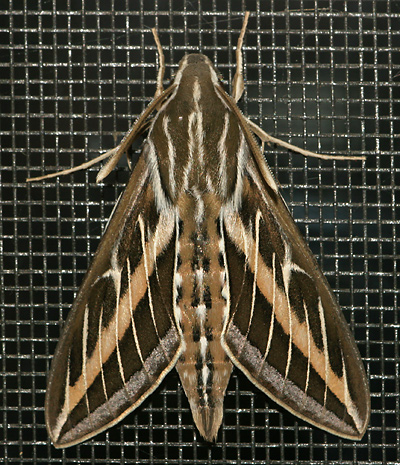
I emerge as soon as the sun set this time of the year, and can often be seen hovering before flowers as I sip nectar.  Occasionally I can be seen in daylight zooming around the garden, especially late in the season.  I am an amazing flier and have often been compared to a nocturnal hummingbird.

I am easily recognized by my large size, big eyes, furry brown thorax and six white stripes, tan band down each forewing with a row of white-lined veins across the forewings and by my pink and black hindwings.  Unlike my more svelt butterfly cousins…I have to beat my wings very fast just to stay aloft…a characteristic that enables me to hover in mid-air like a hummingbird.

Being a mainly nocturnal flier, I prefer white or other pale tubular flowers which are easier to see in the evening.  During daylight I can often be seen feeding at red or other brightly colored flowers…quite a contrast to my night-time color preferences.

The larvae of some of my more distant cousins can be quite destructive when emerging in your tomato or pepper patch.

Please post your answer as a comment.

Read Full Post »

Bible Gardens

What a nice tour.  Great ideas for my daughter, who teaches kindergarten at a Lutheran School in Grand Rapids.  She was inspired.  We enjoyed wonderful fellowship afterwards as well at Jennie’s home.  My only regret was not being able to stay and walk around.  Another time maybe.  Jennie you certainly are an outstanding host.  Your sweet corn was the best I’ve ever had.  Loved your coleslaw too (and I’m not the only one from the comments).  Thank you for giving us such a great lesson at the gardens and  your entire family for hosting a great feast from your bounty afterwards.

Read Full Post »

Sensory Gardens

Thank you Naida and Chris for your hard work yesterday morning.  The beds look great!  I’m shocked at how much we accomplished.  I finished the Island bed and the one by the bench last night.  Just have a few to pull under the Weeping Willow tree. I’ll take care of that in the next few days.  How rewarding it was when I left yesterday morning to see a family at the picnic table (gingham table-cloth and all) under the Willow preparing for a picnic lunch.   Again last evening folks were enjoying that same table, without the branches in their faces.  That made it all worth it.  It was nice to have community members thank us for what we were doing.  I’m happy it is so appreciated.

Read Full Post »

Mystery Bug #1

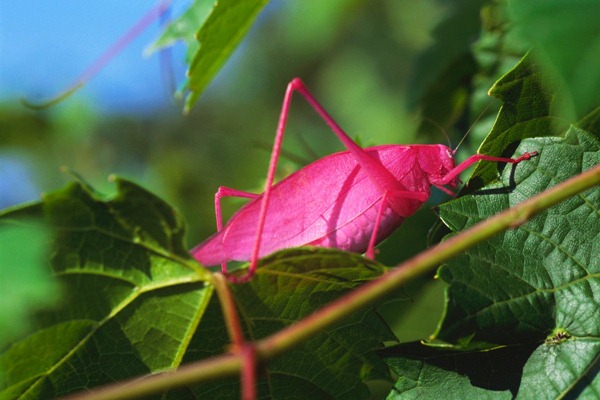
Really-Pink-Katydid_thumb2This insect has an uncommon genetic mutation which results in its bright pink color. It is found in our area during this time of year. Name the mystery bug. Bonus if you can name the mutation! Post your response as a comment. Winner gets bragging rights!

Read Full Post »

When one is spending a long holiday weekend spreading a mulch pile big enough to be seen on Google Earth (no exaggeration!), one has time to ponder stuff. All summer I’ve been looking at some gross looking stuff on the mulch pile and in my beds. I’d been throwing it whole into a brush pile in our woods, but I couldn’t keep up with it. I did some research and – lo and behold! – it is slime mold. Probably most of you are very familiar with it, but I’m a newbie at this gardening thing and it was new to me. Here’s what I learned: slime molds aren’t really molds at all. Molds are fungi. Fungi are included in the Plant Kingdom. Slime molds are included in the Kingdom Protista. When did we get a new taxonomy kingdom? Last I knew (Biology II, 1974) there were only two. Kingdom Protista is the “not animal, not plant, kinda weird, everything else” kingdom, and includes single-celled life forms such as protozoa, amoebas, and other organisms, including slime molds. The cool thing is slime molds can move! Slime molds such as Physarum polycephalum are actually just one enormous cell with millions of nuclei. This giant cell has locomotion, but you’d need time-lapse photography to see it. Slime molds are most prevalent during wet seasons (like this spring), and feed on bacteria and fungal spores found in mulch and turf. They start out looking like something the cat yakked up, kind of clear and slimy, but over a short time they solidify, becoming yellow, pink, or some other weird color. Over time they turn tan or brownish as they dry out. They’re not harmful, but if their looks bother you, just scoop them up whole and pitch them out of your garden. You can’t really get rid of them, though, so why bother? I found these organisms really intriguing when I read about them. If you want to read more, here’s a cool article I found and used for this blog: http://herbarium.usu.edu/fungi/FunFacts/slimemold.htm .

As I was finally seeing the light at the end of the tunnel on the mulch, I remembered an inservice education I had last year at the hospital where I work, about Composter’s Lung. (Well, actually it was billed Hot Tub Lung, because that sounded more exciting, but it’s pretty much the same thing. When I saw the organisms involved, with my new MG knowledge fresh in my mind, I said, “those are compost organisms!” The pulmonologist said, “yes, it is also called Composter’s Lung, if that’s how the person actually got the illness. But I digress.) Composter’s Lung is actually a hypersensitivity pneumonitis, a severe reaction caused by an intense exposure to small particles of biologic material. Organisms in compost and mulch that can cause illness include thermophilic actinomycetes, including Aspergillus species. A person breathes the in the offending organism which causes an allergic response, similar to hay fever or asthma. Repeat exposures cause the hypersensitivity response, which is often confused for other lung illnesses, and occasionally can be quite serious. People who tend to have allergies or sensitivities are most likely to be affected. It takes pretty large exposures, often over extended periods of time, to affect people. The incidence of illness is extremely low, considering how many people spread mulch and compost, so this isn’t something I’d lose sleep worrying about. However, it might not be a bad idea to use a mask if you’re working with mulch, compost, or damp or moldy  straw. If you’re interested in reading more, there are all kinds of articles available on the internet. Here’s the one I used for this blog: http://www.emlab.com/s/sampling/env-report-01-2006.html . Photo credit –  No. 14 from Soil Microbiology and Biochemistry Slide Set. 1976. J.P. Martin, et al., eds. SSSA, Madison, WI

Rats, I spent all my time writing about gross stuff and forgot to take a few quick photos of how nice my beds look, what with all the new mulch and all. Tomorrow….

Read Full Post »

« Newer Posts - Older Posts »