 When one is spending a long holiday weekend spreading a mulch pile big enough to be seen on Google Earth (no exaggeration!), one has time to ponder stuff. All summer I’ve been looking at some gross looking stuff on the mulch pile and in my beds. I’d been throwing it whole into a brush pile in our woods, but I couldn’t keep up with it. I did some research and – lo and behold! – it is slime mold. Probably most of you are very familiar with it, but I’m a newbie at this gardening thing and it was new to me. Here’s what I learned: slime molds aren’t really molds at all. Molds are fungi. Fungi are included in the Plant Kingdom. Slime molds are included in the Kingdom Protista. When did we get a new taxonomy kingdom? Last I knew (Biology II, 1974) there were only two. Kingdom Protista is the “not animal, not plant, kinda weird, everything else” kingdom, and includes single-celled life forms such as protozoa, amoebas, and other organisms, including slime molds. The cool thing is slime molds can move! Slime molds such as Physarum polycephalum are actually just one enormous cell with millions of nuclei. This giant cell has locomotion, but you’d need time-lapse photography to see it. Slime molds are most prevalent during wet seasons (like this spring), and feed on bacteria and fungal spores found in mulch and turf. They start out looking like something the cat yakked up, kind of clear and slimy, but over a short time they solidify, becoming yellow, pink, or some other weird color. Over time they turn tan or brownish as they dry out. They’re not harmful, but if their looks bother you, just scoop them up whole and pitch them out of your garden. You can’t really get rid of them, though, so why bother? I found these organisms really intriguing when I read about them. If you want to read more, here’s a cool article I found and used for this blog: http://herbarium.usu.edu/fungi/FunFacts/slimemold.htm .
 As I was finally seeing the light at the end of the tunnel on the mulch, I remembered an inservice education I had last year at the hospital where I work, about Composter’s Lung. (Well, actually it was billed Hot Tub Lung, because that sounded more exciting, but it’s pretty much the same thing. When I saw the organisms involved, with my new MG knowledge fresh in my mind, I said, “those are compost organisms!” The pulmonologist said, “yes, it is also called Composter’s Lung, if that’s how the person actually got the illness. But I digress.) Composter’s Lung is actually a hypersensitivity pneumonitis, a severe reaction caused by an intense exposure to small particles of biologic material. Organisms in compost and mulch that can cause illness include thermophilic actinomycetes, including Aspergillus species. A person breathes the in the offending organism which causes an allergic response, similar to hay fever or asthma. Repeat exposures cause the hypersensitivity response, which is often confused for other lung illnesses, and occasionally can be quite serious. People who tend to have allergies or sensitivities are most likely to be affected. It takes pretty large exposures, often over extended periods of time, to affect people. The incidence of illness is extremely low, considering how many people spread mulch and compost, so this isn’t something I’d lose sleep worrying about. However, it might not be a bad idea to use a mask if you’re working with mulch, compost, or damp or moldy straw. If you’re interested in reading more, there are all kinds of articles available on the internet. Here’s the one I used for this blog: http://www.emlab.com/s/sampling/env-report-01-2006.html . Photo credit – No. 14 from Soil Microbiology and Biochemistry Slide Set. 1976. J.P. Martin, et al., eds. SSSA, Madison, WI
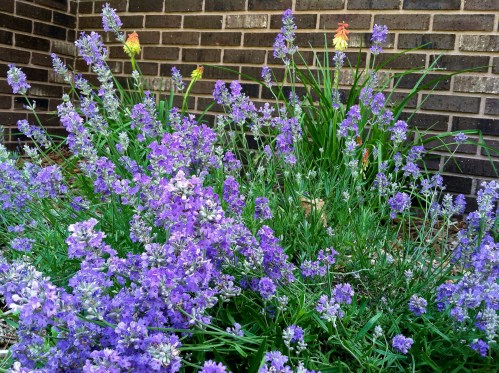
Rats, I spent all my time writing about gross stuff and forgot to take a few quick photos of how nice my beds look, what with all the new mulch and all. Tomorrow….











 Monroe County Master Gardener Association