I did a bit of web searching on the very popular Clematis on my side yard. I’ve included some photos for you. This seemed to be the hit of the Garden Tour and many were interested in its name. During my web search I’ve discovered Clematis heracleifolia. There seems to be a few varieties so I suggest you search Images and choose the one you like best. I’m still unsure of the variety of mine. The bloom seems to match “Jouiniana” however the foliage doesn’t seem to match exactly. This information however may give you a head start to find this prolific bloomer.
Here’s a post from Jennie Stanger. This sounds like a great daytime place to visit.
Rakers is a large wholesale greenhouse operation near Litchfield, MI. It does a huge annual display garden that consumers can visit in August. You can see some photos at http://trialgardens.raker.com/ Several major seed suppliers like Syngenta and Jelitto pay the grower to trial their newest varieties and to plant a large, designed raised bed to show off their combinations, plus Rakers has some demonstrations of their own. I got to go along with the Milan Garden Club for a scheduled tour last week and it was well worth the trip. Besides, we visited Hillsdale’s small college arboretum and a neat succulent place all in the same day.
The greenhouse tour reminded us of Four Star except they grow more plants from seeds. Some of the points we found interesting were the need for stripping media from the roots of cyclamen seedlings when transplanting, so that the forming tuber can be placed atop the next container where it gets exposed to light; the air-conditioned “editing” room where machines and people fix plug trays by plucking out empty cells and replacing them with plants from another tray; the FEDEX shipping containers shaped to fit into an airplane fuselage and carry boxed plants from Rakers around the world; and of course the lush irrigated plants on display.
In this bed at Rakers’ hot colors prevail. In the second photo a new Echinacea “Pow Wow Wild Berry” is a little overwhelmed by its neighbors and you can see the features that made it an All-America selection this year: compact stature with intense flower color on wide petals. It probably would be better in the front of the border and the designer may have been thinking of more normal-sized coneflowers.


Posted in Uncategorized | Leave a Comment »
I have a small collection of Echinacea commonly known as Coneflower. Thought I’d share a few of the photo of those in bloom now. They’re about the best flower for adding color to the garden during this heat wave.
The images include Hot Papaya, Coconut Lime, and the common Purple. It’s best to cut off the blooms the first year you plant from the nursery. I know, it’s a hard thing to do, however, the result of letting it build a great root system
will reward you next year. Many people think they’re hard to grow for that very reason. The plant puts so much of its energy in the bloom and not the root that they often don’t survive. They are easy to grow. Coneflower is known to get black spots (botrytis) and powdery mildew at times. If you find no petals on the bloom or the foliage is yellow then it’s probably aster yellows which has no known cure. It’s spread through leafhoppers. These pests hop from plants when disturbed sucking from the stems.
Every year a few new hybrid introductions are made. I’ve been loving the “Orange” and Hot Reds that have been introduced the past few years. Planted a few more this year, but cut off the blooms to let those roots grown. Guess you’ll have to wait till next year for those.
Posted in Uncategorized | 2 Comments »
Carol K (mgmgaclk1) wins the mystery plant challenge this week! It is indeed Iris spuria “Shelfold Giant”. Carol, if you want to choose the next mystery (plant or bug) email me individually with your choice!
Thanks for your replies, everyone! This is such a fun way to learn.
Posted in Mystery Plant | Leave a Comment »
I feel kind of guilty posting these photos. They are nodding thistle (aka musk thistle) and they are highly invasive, but, OH, they are so pretty, and they smell wonderful! If you are cleaning out your ditches or pastures, you can enjoy them for awhile in a bouquet, just be sure to burn them or bag them tightly in your garbage so no seeds get into your environment. (If you single click on a photo, they will enlarge on your screen and you can scroll through them.)
Posted in FotoFriday | Leave a Comment »
Carol Koesel uses Genista lydia in her garden and provided our readers some great images and information about this little used shrub. For people with sandy soil, this could be a great choice for adding an interesting, colorful spring specimen. Here’s what Carol has to say:
I am not a big fan of “hot” colors in my yard. I lean toward the cool blues and purples, pale pinks and multiple shades of green, but in the spring and early summer I appreciate pops of yellow to light up darker corners.
I’m also a big fan of woody ornamentals, natives as well as the more unusual genuses.
I think I first encountered Genista in the “High Country Gardens” catalog, or maybe it was in Dirr’s illustrated Hardy Trees and Shrubs, but it was the perfect plant for the shrub border screen in the back yard. I did find it container grown locally, but have not seen it since. Perhaps it can be ordered.
Genista lydia is a low growing groundcover that matures to about 1 foot tall and up to 5 feet across, and can be easily shaped or pruned if necessary. Said to be hardy in zones 6-8 (9), it has done well in my yard for the past 8 years. It prefers dry, sandy soil and full sun; it detests wet feet. For two to three weeks in late May to early June it literally vibrates with chrome yellow color. Otherwise it is a prostrate, small-leaved, dark olive green.
It under plants a Blackhaw viburnum trained to a standard and a Cornelian Cherry dogwood in this border and is backed by ‘Emerald Green’ arborvitae, ‘Black Lace’ elderberry and ‘Tiger Eye’ sumac.
Posted in Perennials, Trees and Shrubs | Tagged woody perennials, yellow shrubs | 1 Comment »
This week we have two very different kinds of garden photos. Linda sent in a fitting entry – a Memorial Day garden theme incorporating an eagle, stars, and poppies. Linda, you never cease to amaze me with your ideas! Our other photo comes courtesy of Diane, who captured (photographically speaking) a baby bunny nest while working in the demo gardens. Yes, I know that rabbits can be a garden pest, but you have to love looking at the babies!


Posted in FotoFriday, Uncategorized | 1 Comment »
They say that new plants take three years to establish but in the case of these three woody ornamental shrubs in my yard, five years is the magic number. These three shrubs, planted in 2007, are stunning performers in my garden this year. I love using flowering shrubs for three season interest and ease of maintenance. A bit of organic fertilizer or compost is all I have used on these shrubs, usually applied early in spring prior to blooming.

This Weigela was loaded with blooms about two weeks ago. I have included a close up of the cone shaped blossoms.

Gorgeous creamy pink blossoms complement dark purple foliage on this stunning Proven Winner Selection Sambucus nigara ‘Eva’ Blace Lace Elderberry. I have let it grow free form rather than prunning.

Physocarpus opulifolius ‘Mindia’ Ninebark ‘Coppertina’
Posted in Trees and Shrubs | 1 Comment »
I certainly can not take credit for this creative idea and don’t really know where it originated from. I saw a photo on the web and thought this is perfect for me to do for the class I’m giving this evening on Vertical Gardening at Riverside school.
Posted in Uncategorized | 2 Comments »
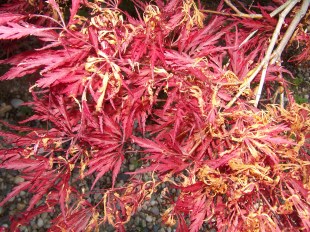
In the past two weeks I’ve had several people in Irish Hills, Clinton Township and Monroe come up to me and ask me what’s happening to their Japanese Maple. Even my husband made a remark about it because he thought ours was dying. Relax, it’s not a serious problem. It’s frost damage. About two weeks ago we had that 20+ degree night and frost the next morning. This is the result. If your tree is looking like the photo below it got hit with the frost. To improve its appearance you can take your shears or pruner and cut back the damage leaves. It may leave a tiny bare area but that will look better than those frost bitten foliage. No need to prune it back to the hardwood, just trim off the stem and dead foliage. It’s time-consuming, but it will look so much better. I wanted to post this for other public readers who follow our Blog.
Posted in Educational, Trees and Shrubs | Leave a Comment »

