Feeds:
Posts
Comments

Would I miss a pruning session with Bob Tritten?  Not likely!  I was all prepared to pay $25 to attend  his last appearance at the Tollgate Farm orchard – so it was a treat not to have to make the drive and only pay $5 thanks to the generosity of our local Conservation District in bringing him to Jennie’s farm.

Getting set up

Braving the early morning chill and temperatures in the mid-thirties, I joined an eager crowd of about thirty five, including nine Master Gardeners, watching this master arborist  working magic with his clippers.  The only casualty was the MG camera whose batteries didn’t like the frosty weather – but this time I brought spares.  Sue’s camcorder also suffered the same fate.

Every time I visit Jennie, I always make a mental note of how good her fruit trees look!
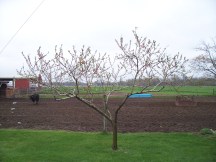
The perfect peach


We were all a little dismayed when after a few minutes of Bob’s careful pruning, about 30% of what appeared to the backyard novice as a perfect peach tree – was lying on the ground!  And Bob made such drastic surgery all appear necessary and quite appropriate with his easy to follow commentary.


The perfect peach”after”

I last saw Bob in action about 13 years ago, climbing trees with a chainsaw and his other tools hanging from a belt – renovating an ancient orchard in Monroe. For those who don’t know, Bob is the Genesee County Extension Fruit Tree Specialist among other things.  This means that he trains commercial orchard owners and workers how to prune fruit trees for maximum health and productivity.  You can see his handiwork at Applewood Orchard just over the county line.

The lesson began with a brief explanation of the tools of the trade – from an array of familiar Felco and Corona hand clippers, diamond sharpening stones, venerable wooden handled hand loppers, from the high end to the cheapies you lend your neighbor, pole pruners, wicked looking hand saws, a trusty gas chainsaw – to artful branch spreaders, ropes and a few good books on backyard fruit growing.
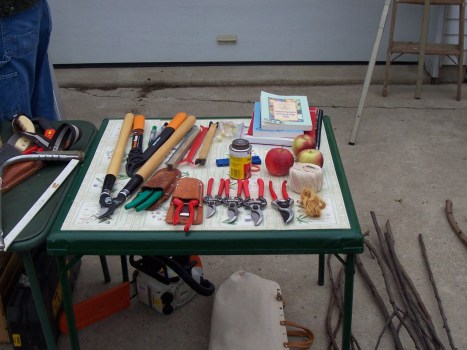
The tools of the trade

He is still recommending one of my favorites, Stella Otto’s” The Backyard Orchardist”.  The ergonomic Felco #8 clippers and the 18″ Turbo pruning saw are on my short list as must haves.  A. M Leonard has them in their catalog along with everything you could ever need for any gardening or growing project.  www.aml.com

He asked if we knew the differences between pome fruit – apples, pears, etc all having small seeds – and stone fruit such as peaches, plums, apricots, etc.  For those of you who have forgotten, please dig out your green book and look under Fruit Trees!  Jennie will cover these in a later follow-up article.  He stressed  the need to be familiar with these two types of fruit trees as each requires special pruning, which he would address when we went through the orchard.

For demonstration purposes, he showed how to break in a new tree with three rapid cuts on a poor unsuspecting apple whip.  His technique was simple and easy to follow.
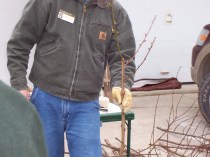
Sizing the young tree

In the case of the apple, he first sized the tree to hip height before making the radical cuts, which he said was essential  for good future branching.  He showed the three (3)  alternating buds at differing heights he wanted to keep which would form the future scaffolding branches of the growing tree.  He also demonstrated how to maintain and encourage the Xmas tree shape that is desirable in pome trees.
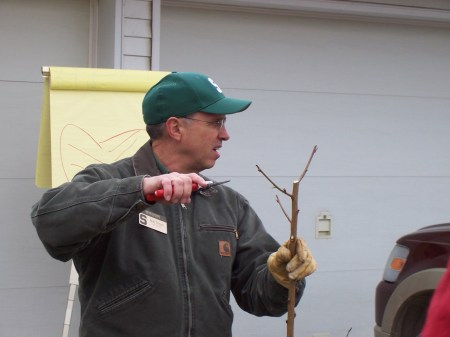
Apple whip showing a three branch scaffold

Next were the peach and apricot which require a more open, heart shaped structure.
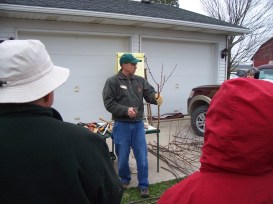
Desired open heart shape for a peach

He achieved this desirable shape by removing the heart  and just leaving three (3) opposing lateral branches at about a 70% angle to the trunk to form the scaffold.  Bob likes to be able to throw a football through the center of the tree!
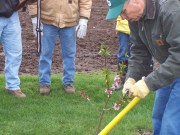
Shaping a young peach tree

Before moving out into the field, he showed how to train or renovate a slightly older tree – by using short wood spacers, clothes pins, weights or even a rope tethered to a stake  –  as a means of improving the angle of the  fruit bearing branch to the trunk.  These aids remain in place or until the tree attains the desires shape.

Branch spacers and spreaders

As we followed him into the orchard, he gave a fast analysis of the tree ahead, and what he would do to improve things.  In spite of an artificial shoulder and being well into his sixties, Bob is still remarkably agile in the air on his sturdy three legged orchard ladder.
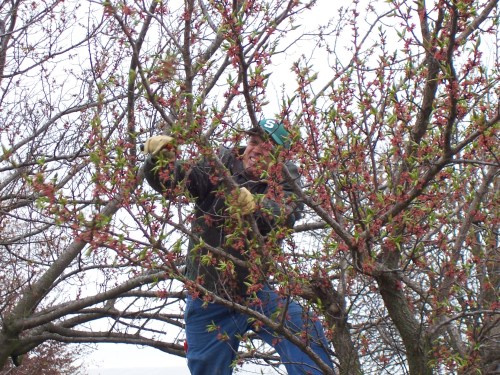
Shaping the tree from above

In no time he was lopping out watersprouts and ingrowing or crossing branches, as he brought the shape of the tree into a better form for maximum fruit production.
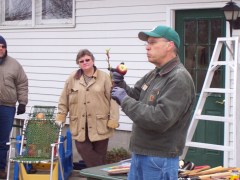
Blossoms do become fruit!

He stressed that you almost have to plan two (2) years in advance to get a structure that will yield blossoms that develop into fruit the following year.

I plan to have another article on some more of the specifics he covered in his lengthy presentation. Jennie will also post a more in depth one on the whys and wherefores of pruning.

Sue is currently editing down about 2 1/2 hours of video tape into shorter YouTube videos, that she will post as instructional aids that will be available for download by our blog readers.

Our thanks go to the Monroe County Conservation District and staffers, Catherine Acerboni and Bob Potter, for arranging the session – and to fellow Master Gardener and former Monroe County Horticulturalist, Jennie Stanger for graciously opening her farm for the event, and letting her orchard become the subject of the lesson.

Frank.
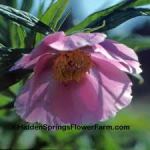
I am feeling generous –  it’s a Peony!

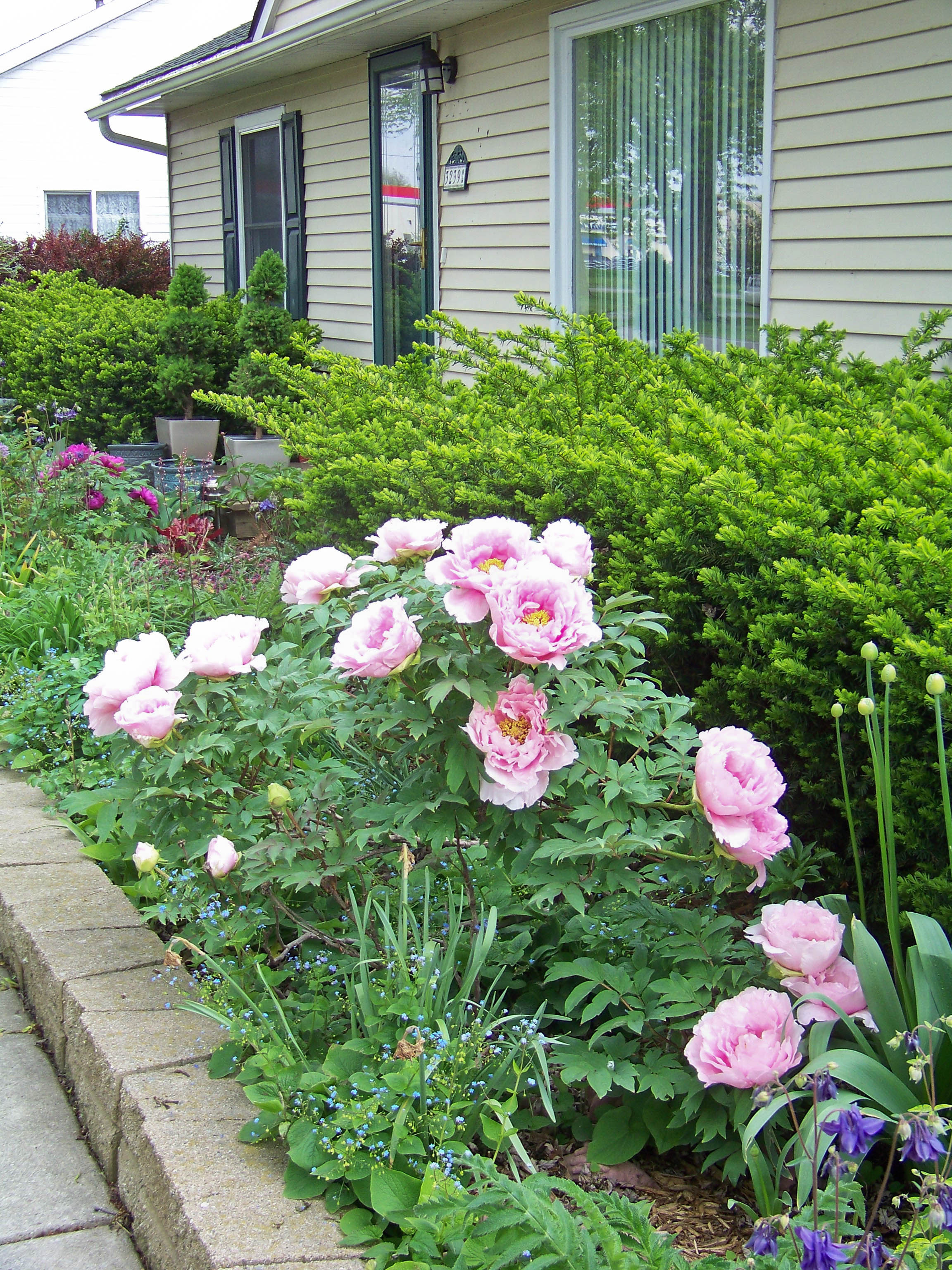
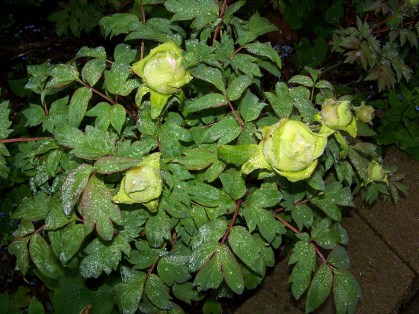
For those who haven’t read Linda’s recent article on the peonies in her garden – you should!  These queens of the garden truly deserve a place in everyone’s landscape with their fragrant flowers and beautiful centers.

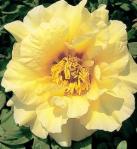
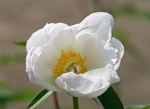
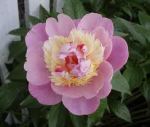
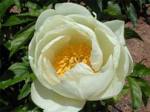
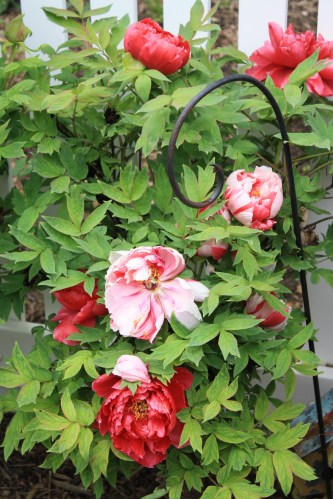
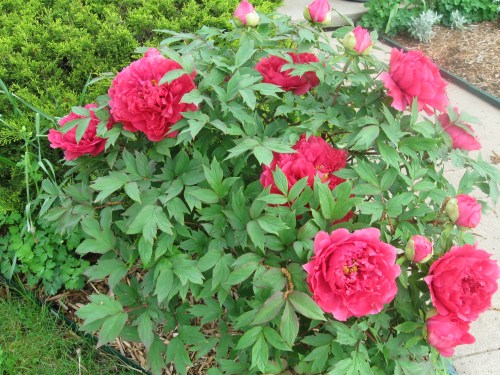
In my comment/reply, I mentioned we had a few peonies in the demogarden. Well, surprise – we have quite a selection, and all are from Reath’s Nursery in the Upper Peninsula!  Your quiz will be to match the peony to the location in the garden.

Wind Chimes Peony
(A)

Age of Gold Peony
(B)

White Innocence Peony
(C)

Raspberry Sorbet Peony
(D)

Prairie Moon Peony
(E)

Krinkled White Peony
(F)

Early Windflower Peony
(G)

(1)   Entry Garden;   (2)   Perennial Garden;   (3)  Sign Garden;

(4)   Children’s Garden;  (5)   Memorial Garden;  (6)   Spruce Garden;

(7)   Native Shrub Garden.

I would suggest printing out the sheet and entering your location answers alongside the photos.  This is an excellent way of brushing up on the plants in our demogarden. Jennie has kindly agreed to mediate any disputes.

To make it a little easier, I have named each variety shown in the above photos. Please post your answers as a Comment, e.g. D2 or B6.  There are the usual trick entries – so don’t be fooled!   As an added bonus, identify the tree peony for Advanced MG status.

The winner(s) will have the usual bragging rights of showing their superior knowledge of the plants in our gardens.

Frank.

Linda Welch sent in photos of her tree peony specimens. They are stunning! I posted these in “gallery” style. Click on the first photo and you will be able to view each of these as a large image and you can advance to the next photo by clicking on the arrow. These are definitely worth viewing large!

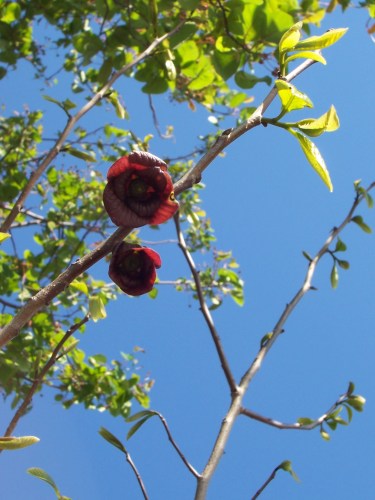
I am a large perennial shrub or tree growing to 35 ft, and am a member of the Magnoliales order.  My native habitat stretches from the Southeast, through Pennsylvania and the East Coast and parts of the upper Midwest.  I am often found growing in deep fertile bottom lands, as well as hilly upland areas.  My growth pattern is to form a dense thicket of tall slender trees and often provide an understory component in my preferred habitats.

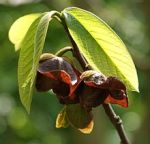
I have large, simple leaves and the largest edible fruit indigenous to the US.  My leaves cluster symetrically at the ends of my branches.  They are wedge shaped at the base and are alternate and spirally arranged.  Being deciduous, my leaves turn a rusty yellow in the fall.  Otherwise they are wedge shaped at the stem, with a grey rusty underneath and a hairy upper surface.

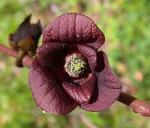
My flowers are quite unusual, in fact I often resemble a maroon Campanula when in bloom.  They are 1-2″ across, rich red-purple or maroon in color…and are produced in spring from April to May just before the leaves appear.  My flowers are composed of three sepals and six petals, arranged in two tiers and are pendulous.

Pollination is somewhat different for me in that the yeasty smell of my flowers attracts more blowflies, fruitflies, carrion beetles than honey bees.  I am reasonably shade tolerant and my leaves, twigs and branches have a slight disagreeable odor when handled.

My fruit has been described as being showy and the main distinguishing factor in giving me my common name.

Please post your answers as a comment.  The usual bragging rights go to the one with the correct answer.

In design we often add collections to an interior to accessorize our rooms.  A collection will be an item of similar content, shape, or maybe color.    There are numerous variations to a potential collection.

This is true also in our gardens.  We all have favorites for our garden.  There are popular favorites of well-known plants such as hosta, roses, herbs and succulents that we often find in gardens.  There also are collections of more rarely known plants.  This summer I hope to post information on some of my favorite collections.  These collections will vary in categories for species, color, texture etc.   I’m hoping you will enjoy this series of articles and the information added about my experience with the collection.

My Favorite collection:

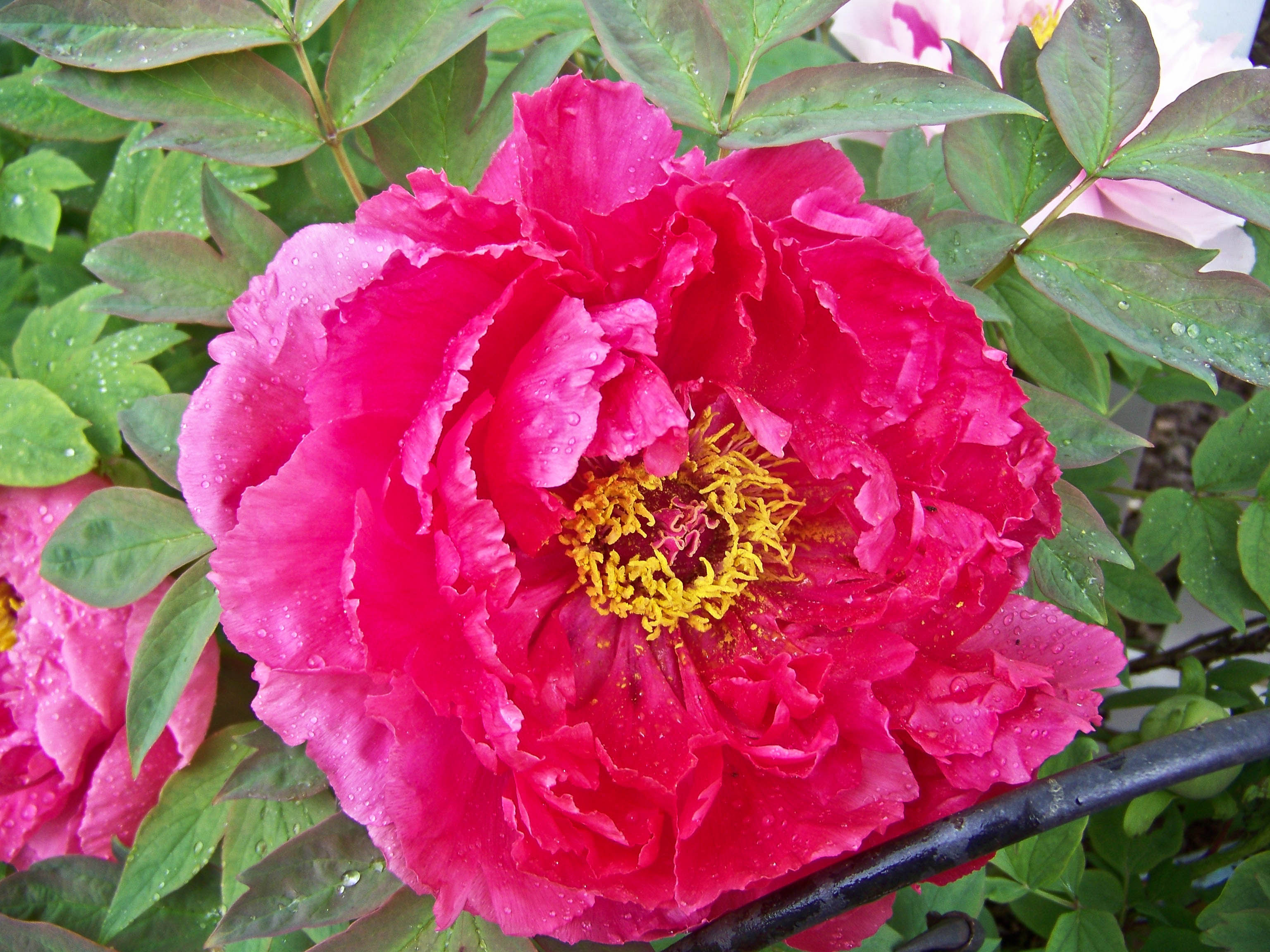
One collection I have in my Garden is the Peony (genus Paeonia.)  I have a few varieties of the Herbaceous type, but also collect the more rarely grown Tree Peony and Itoh Peony.  The one surprise is that most people feel that this species are more difficult to grow.  By far, they are extremely easy to grow and bless you with the largest most fragrant blooms.  I have found that they are less susceptible to disease as well, such as Powdery Mildew often associated with the Herbaceous varieties.   Although it is best to plant and transplant them in the Fall, they easy adapt to Spring planting with frequent watering.  It’s best to water them as you would a newly planted tree.   The Tree Peony grows on hard wood and is a deciduous shrub.  It does not die back to the ground as the more common Herbaceous peony or the more recent introduced Itoh Peony.

Hu Shui Dang Xia

In my collection of Tree Peonies is this pink variety named Hu Shui Dang Xia.  A year ago last fall I moved two from either side of this one to new locations.  They were gaining such height and width in this small area.  Most will grow up to 40″ high and 30″ wide.   So if you add one or more to your garden plant with it’s growth in mind.

   The Itoh is a cross between the Herbaceous and the Tree Peony.  It incorporates the best of both, but it does die back to the ground.  Both the Tree Peony and the Itoh Peony are more expensive than the standard Herbaceous; but you must agree they give you your monies worth in a beautiful flower.

Itoh Kopper Kettle

I have had great success growing these in even partial shade.  Often one plant will have as many as 20-25 buds that will bloom into various size flowers.  Most opening to 6″ or more.  They are great survivors of hard winters as well.  Most are good to Zone 4.

You will notice that the Tree Peony does not have that same round bud as the more popular Herbaceous peony.  It has a large more pointed shape.  Since they are on a hardwood, they also hold up better after a hard rain.  Often a good shake after a rain is needed just to open up the bloom petals that the rain cause to stick to one another.   With it’s stronger stem, the Itoh holds up much better to the rain as well.


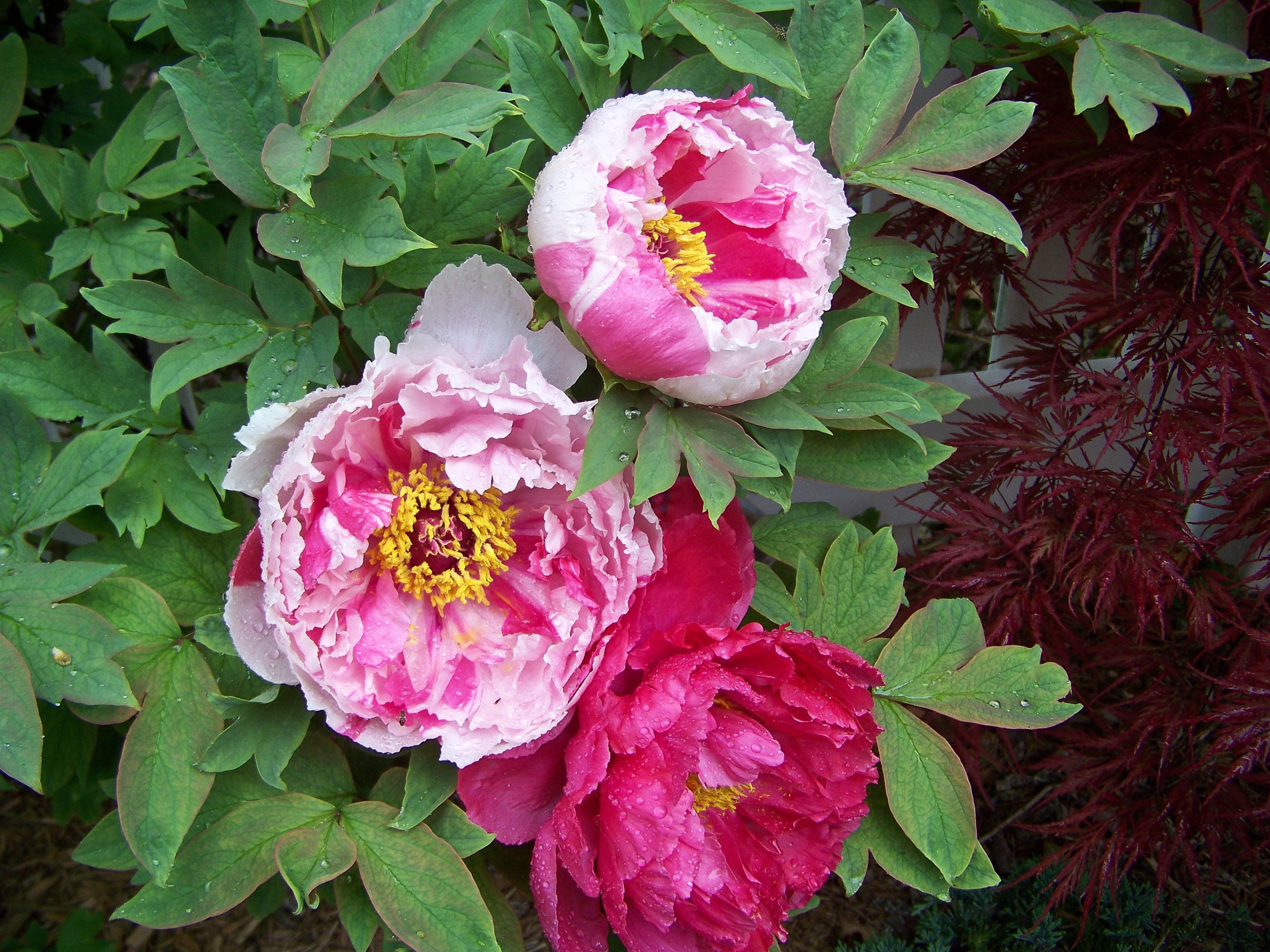
Shimanishiki :  A semi double with red and white stripe.  You will notice some flowers come through with just red and others stripe.  It is very interesting to see what you will get from each bloom.  The colors are due to mutation, thus, no two are identical.

They make great cut flowers. However, You must cut the stem short on the Tree variety, so you avoid cutting next years bloom.  Cut only down the stem to where you see a newly forming node.  That is where the new bloom will develop for next year.  Since Itoh die back to the ground you need not worry about the length on these cuttings.  They last a good while in a vase with fresh water and will fill the room with an aroma you will never forget.  Oh yes, the plus…no ants to deal with in the flowers.  The photos are from last year (except the one of buds).  I will post photos on Foto-Friday when they bloom this year.

Naida Albin has photos of her Tree Peony to share.  I’ve attached them below:


We all have one or two all-time favorite tools. (You know, the ones you don’t loan to the neighbors because you know you’ll never get them back.) As we all burst into spring gardening chores, we’d like to know your favorite tools, brands, best price, why they are your favorites, etc. For starters, what are people’s choices for bypass pruners?

I remember Jennie showing us her scuffle hoe in a master gardener class. The closest I’ve found to it is the Flexrake CLA110 Classic Triangle Weeding Hoe that I found on Amazon for about $30. It seems very well made, has a nice feeling wooden handle, and works well. I just bought it last year so I can’t endorse it yet for longevity.  I’ve also heard people raving about the Hori-Hori knives, but I’ve never seen one. I found a youtube video comparing them to a similar, less expensive tool.

What are your favorite tools? What are are your likes and dislikes? How expensive are they? Where can we find them?

With my daughter’s wedding taking all my attention the past several weeks, I haven’t been able to work in my beds. The past few days I was able to at least walk around and re-discover what is growing. It is amazing how much pleasure seeing a few lovely things can bring! I took a few photos of some of those simple pleasures – little surprises that caught my eye. Not high art, but they made me happy so I’ll share them. (Click on the photos to view large.)

My flowering crab was shedding blossoms on my hostas. Something about them reminded me of a zen garden.

I liked the repeating vertical lines created by my ajuga against my wood fence.

Little surprises, simple pleasures – just about all the excitement I need for the time being!

With spring well and truly here, it’s time to take off the lens covers and get ready for another season of FotoFriday!   I think we were all hoping for some exciting winter scenes — but this was not to be.

Hey, Mr Postman ---

I have a rather interesting fall rural mailbox scene from a farmstead just down the road from Jennie’s .  This farmer also likes to gussy up his barn with simple planters that never look out of place in the country.

Thanksgiving feast for a hungry squash borer.

Sue will be back in the director’s chair next week, with possibly some very interesting nature scenes from her recent time in Mississippi.  In the meanwhile, please send her your apple and cherry blossom and other springtime photos. She can “fix” just about anything from a wedding reception to fuzzy photos — so don’t be put off if your snapshot isn’t of magazine quality!  We want to see what interests you, and what’s in your garden.

Ornamental Kale

Frank.

Just a brief reminder to everyone that the third season of this popular downtown Dundee attraction is about to begin.  For those who aren’t familiar with Dundee, the open air market is located at 223 Tecumseh St (M 50) in the parking lot next to Diane’s Freeze.

The market will open for the summer season on May 19 and every Saturday thereafter at 8.00am – 1.00pm, and Wednesdays from 4.00pm – 7.00pm through fall.  About 25 vendors are in attendance featuring locally grown vegetables, cut flowers, herbs, bedding plants, patio pots and planters, crafts, honey, homemade jams and jellies, baked goods, artisan breads, and even locally produced meats.  As an added draw, there is generally some form of live entertainment during the season to add to the festive fare.

Sean McClellan, the Market’s coordinator, has requested that our Master Gardener Association set up an information booth to answer general lawn and garden questions from the public.  Three of our members have already done this in prior years, and he was wondering if the association would be willing to have a season long presence at the market.   Jennie Stanger, master composter John Eichholtz and Georgeann Brown have all left  their mark with favorable results.  In fact Georgeann often teamed up with fellow MGs, the Chapmans—demonstrating different ways to present their lamb with herbs from her potager garden.

This would be an excellent opportunity for the association to establish a working relationship with a popular Farmers Market and make our presence known to the public by sharing our gardening expertise.  I am suggesting the booth be staffed by 2-3 members, with possibly a short demonstration of a simple garden topic.  Sean will provide the table and I believe the MGA has signage and other props at the extension office.

Hopefully this idea will be met with approval after discussion at the next meeting, and a committee set up to coordinate the activity.  Sean and his wife Tanya, publish the Independent newspaper—I am sure the MGA will get a lot of free publicity out of this collaboration.

Sean’s contact info is:  (734)  529-7275;  email:  sean@dundee.net  and the website for the Farmers Market, which has some excellent photos of the market activities is:  www.dundeefarmersmarket.com

For those who still want to record their hours, I am sure this will be counted as approved educational time.

Frank.

(second in the Cutting Back series)


Click Here to See the Current Area Map


Joan Otter and Karen Bender met me at the demo gardens today and we worked through very cool breezes with a spatter of snowflakes, on cleaning up the northeast side groundcover area that they have decided to adopt, and pulling a few dozen clumps of garlic mustard here and there.  We discussed a plan for changes but did not want to disturb the iris/violet combination blooming at its peak just now.  Some of the pink daisy mums were dug to move but more are available for adoption as are the remaining plants listed for removal.

The groundcover areas frame the entrance to the building, so they are very noticeable. They get only morning sun, and due to the overhang, very little rain in summer, so the plants growing there are very drought-tolerant. Still, few survive right next to the building. Another stressor is the salt from the sidewalk and parking lot applications.  Since about 1995, we have removed more than half the old overgrown and badly pruned junipers from the area and tried to keep the remaining ones pruned regularly and well. Since those hardy shrubs thrive, cover ground and provide winter interest, we should hesitate to remove the last few.  Some of the groundcover plants thrive as well, crowding weeds out of their areas and requiring little maintenance. Lately we have tried to let them fill their spots and decrease the higher-maintenance plants.  2011 was the first year we have mulched those beds because our goal was to cover the ground with living groundcovers.  Realistically, it is too dry and difficult an area to do that well, particularly along the building.  Mulched spaces between the remaining groups will conserve water and moisture and avoid the weedy look.

On the other hand, a coarse mulch of wood chips makes some of the groundcovers more difficult to maintain by shearing them back after flowering, which they need badly, so those should be eliminated.  Maintaining some of the perennial groundcovers where tulips and daffodils are planted will help camouflage the bulb foliage as it dies back.

Plants to be removed from this area in 2012: mother-of-thyme, lamb’s ears, blue fescue, silver mint.

Plants to divide and replant in a different spot; dwarf iris and violets, Herman’s Pride false lamium, coralbells, Korean mums.  The Andorra juniper was pruned rigorously and if it doesn’t improve in appearance, it may be removed.

Plants to be added; perhaps the dwarf reblooming yellow iris and ‘Happy Returns’ daylilies from the rain garden; try some “hens and chicks” along the building wall near the container.

Maintenance: Deadhead lungwort and bergenia by May 1. Moved plants are likely to need occasional watering in summer.  More mulch may be needed after plants are removed.