Feeds:
Posts
Comments

Archive for the ‘Uncategorized’ Category

If you compost and find an odor comming from it…here are some tips:

Sulfur Smell:  Your pile may be too wet and it lacks oxygen.  Aerate the pile by turning and let the pile dry out or add more dry material to it.

Ammonia Smell:  Chances are your kitchen scraps are not covered.  Add some carbon-rich material like brown leaves and turn the pile.

Sewage Smell:  If it attracts some files and is smelling like sewage, you may have too much nitrogen.  Bury any scraps in the center of the pile and cover it with soil or brown materials such as leaves.

Read Full Post »

Announcement: MG Maggy Myers reports that the former Jacob’s Garden nursery and greenhouse is open under new ownership as Beauchamp Garden Center. The large facility at Whiteford and Sterns Rd is selling plants now and gearing up for more business. In fact, if you are looking for part-time employment, stop by there and fill out an application!

Read Full Post »

Just in case you have not received the notification for Master Gardener College here is the information. I will add to our Calendar as well

Click to access MG_Booklet_2013_-_FINAL.pdf

Read Full Post »

Sometimes a season can be difficult on a mature tree. After a late frost last spring, a hot dry summer and a somewhat unpredictable winter, I lost my Japanese Maple in my front yard. It was sad to see it go since I planted around its red color. Well, all is not lost. Today I planted a replacement shrub, that hopefully will withstand the strong semi-sunny spot. I needed a pop of colorful foliage. I decided to plant Abelia grandiflora ‘Kaleidoscope’. It has brilliant red stems that contrast nicely with the yellow-green foliage. This plant will have color for each season. In spring it has this green center and bright yellow variegation along the outer edge. In summer, it’ll change to a darker green center with a creamy golden outer edge, and fall should bring green, yellow, orange and red foliage. It also blooms. A white, somewhat fragrant flower appears from summer until fall. It’s known to attract an array of butterflies. Its hardiness Zone is 6 (-10 degrees). Since we are now in 6A (-10 to -5 degrees) I can plant it with confidence. I didn’t want a tall plant there since my arbor gives me the height I need. This shrub will be only 2-3’…about the same height as the Japanese Maple that it’s replacing. It will grow up to a width of 3-4′. It enjoys moist, well-drained acidic soil. I have an azelia nearby that loves the same conditions. I’ve read that it is a neat, compact mounded shrub that requires minimal maintenance. That convinces me that this is the perfect shrub for that area.

Read Full Post »

Spring and fall are good times for planting shrubs and small trees. It’s also when we introduce our annuals to the garden. Best time to plant those annuals is after Mothers Day.  Here are a few suggestions to help out the birds and bees as well as your yard and gardens.

Plants for Birds:  Shrubs and small trees that produce berries for seasonal food and year-round shelter:

1. Dogwood (Cornus florida) Zone 4-9

2. Ninebark (Physocarpus spp.)   Zone 2-8

3. Serviceberry (Amelanchier arborea) Zone 4-8

4. Beautyberry (Callicarpa americana) Zones 5-8

5. Juniper (Juniperus spp.)  Zones 3-9

6. Viburnum (Viburnum spp.)  Zones 2-8

For the Hummingbirds include:

1. Cardinal flower

2. honeysuckle

3. Hosta

4. Bee balm

5. Cannas

6. Lantana

7. Salvia.

Plants for the Butterflies:  Favorites for the Butterfly:

1. Butterfly bush

2. Garden phlox

3. Purple coneflower

4. Cosmos

5. Zinnia

6. Lantana

Plants for the Bees:  All of the above;  if there is pollen they will come.

Read Full Post »

cherry blossom is the flower of  trees of genus Prunus.  Prunus Avium is commonly called wild cherry or bird cherry.  The blossom as you see is white.  This one grows in my neighbor’s backyard.   Although I’ve noticed one brave Robin that protects the area for itself; birds invade this tree mid-summer for the fruit.   Many of us plant cherry trees for the blossom and not necessarily for the fruit.  Many varieties also have pink blossoms.  The tree can form in many shapes as well.  Blossom lovers are known to plant the Weeping Cherry which is one of the most dramatic flowering trees for the landscape. One of the most commonly planted specimens is the Yoshino cherry blossom tree.  Many varieties came to the U.S. from Japan.  When I think of cherry trees the first image in my mind is Potomac Park in  Washington D.C.  Of course next is the thought of trips to Traverse City during cherry festivals.   I’ve not been in Traverse City when the trees are in bloom however.  It must be a beautiful sight.

Cherry tress like well-drained soil in a sunny area. The recommended planting zone is  5-9.  Brown rot and blossom blight are two fungal disease which attack cherry trees. Fall is the best time to apply a copper spray to the tree after the leaves fall.  Fungicide then gets applied when blossoms appear and continued on a weekly basis.   However, be preventative by removing old fruit and leaves from the tree to help avoid disease.

Read Full Post »

Milan Garden Club MembersNaida contacted me to suggest that we feature a Garden Club each month so that we can become familiar with them in case some of us may want to join.  I thought this was a great idea.  We post most events on our calendar as well.  The feature this month will be the Milan Garden Club.  Publicity Chair – Barbara Gardinier wrote the following information on their club.

 MILAN GARDEN CLUB :     COME GROW WITH US!  We welcome new members!

All ages and genders are ENCOURAGED to attend a Milan Garden Club meeting and see what we are all about. We offer informational programs and educational meetings.  We LOVE to go on field trips!

Our community service and member involvements are: Plant and maintain the Friend-Hack House Museum Memorial Gardens; Marble Memorial UMC Gardens; Milan Veterans’ Wall of Honor, and Blue Star Memorial in Wilson Park.

We also participate in “Sponsor-a-Barrel” and “Adopt-an-Area Programs” with the Milan Beautification Commission; Paddock Community and Learning Gardens; Milan Chamber of Commerce; Milan Summer Fest; Milan Area Historical Society, and Michigan State University Extension Offices in Washtenaw and Monroe Counties.

Other things you might like to know about Milan Garden Club:

  1. We have established and now maintain the gardens at historical Friend-HackHouseMuseum since 2000.
  2. We contribute to world and local horticultural foundations, scholarships, and Aid in Milan.
  3. We co-sponsor two Milan Beautification awards to rural 48160 addresses four times a year.
  4. We are members of Michigan Garden Clubs, Inc. and National Garden Clubs, Inc.
  5. Five of our members have earned Master Gardener Certification.

Our mission is to: educate about plant care, stimulate gardening, promote home and community beautification, encourage conservation, share resource information and have fun! 

Milan Garden Club meets on the second Wednesday of each month at 6:45 PM.

During the months of May through September, we meet at Friend-Hack House Museum, 775 County Street and October through April at Marble Memorial United Methodist Church, 8 Park Street in Milan.  Annual dues are $20.00 and membership includes subscriptions to “Thru the Garden Gate” and “The Michigan Gardener”.

For membership or program information, please contact:  Nancy Kuzniar, Membership Chair, 439-1719 or Sandra Miller, Secretary 434-9030.

Read Full Post »

This is truly an old-fashioned favorite.  Easy to grow the lilac came from the Balkan Peninsula in Europe.  It is a member of the Olive (Oleaceae) family.  The common lilac will award you with an abundance of fragrant spring flowers. It provides fantastic spring color every year without fail.  You only need to be near one to smell the fragrance in the air.  This deciduous shrubs grows six to twelve feet tall and will get just as wide; so plant them where they will have plenty of room to grow.  They will typically bloom in mid-spring and are available in various shades and tints of purple, and as well in white.  Their blooms contrast beautifully against their dark green foliage.   These shrubs are best planted in full sun and well-drained soil.  It may also be planted in the shade, however it will most likely not produce the much wanted blooms.  Powdery mildew is known to appear on common lilacs.  There are varieties available that are less likely to have this problem.  You can also make sure that they are planted in an area with great air flow to help avoid this common disease.  They prefer a cold climate and are suited best in Zone 3 to 7.  This shrub requires little maintenance.  You can literally plant it and ignore it.  However, you may want to prun it so that you can reach those wonderful blooms for cutting. Pruning is best done right after the blooms are spent.  This will assure you are not cutting off next years production.  This is a great addition to your landscape.

Read Full Post »

Since it’s often associated with the first sign of Spring and warm weather.  Our feature flower for March is the Crocus.  Did you that the Crocus is a relative to the iris?  Crocus (disambiguation) is a flowering plant in the iris family.  It grows from corms which are actually the storage organ that the plant survives on during the winter, or in adverse weather such as a summer drought.  Crocus are a native to the woodlands and meadows.  Their colors mimic the spring palette of yellow, pinks, whites and blue to lavender purples.  The foliage comes up as a long slender dark green blade, which could be mistaken for grass.  It’s also a favored snack of squirrels.  There are some ways to help with this problem when you plant or after they are first established.   You might try dipping them first in a repellent to discourage the critters, lay chicken wire  or Cayenne pepper on the top of the soil  to discourage digging in the area.  The corms are best planted in the fall in a full sun to partial shade location that has well-drained soil.  The depth should be around five inches.  They will begin to pop up through the last remnants of ice and snow during the day and will close as evening approaches.  This sweet petite fleur sings of spring when you see it popping through the earth.  Although we associate it with spring, there is a species known as the autumn crocus that flowers in late summer and early autumn.

Read Full Post »

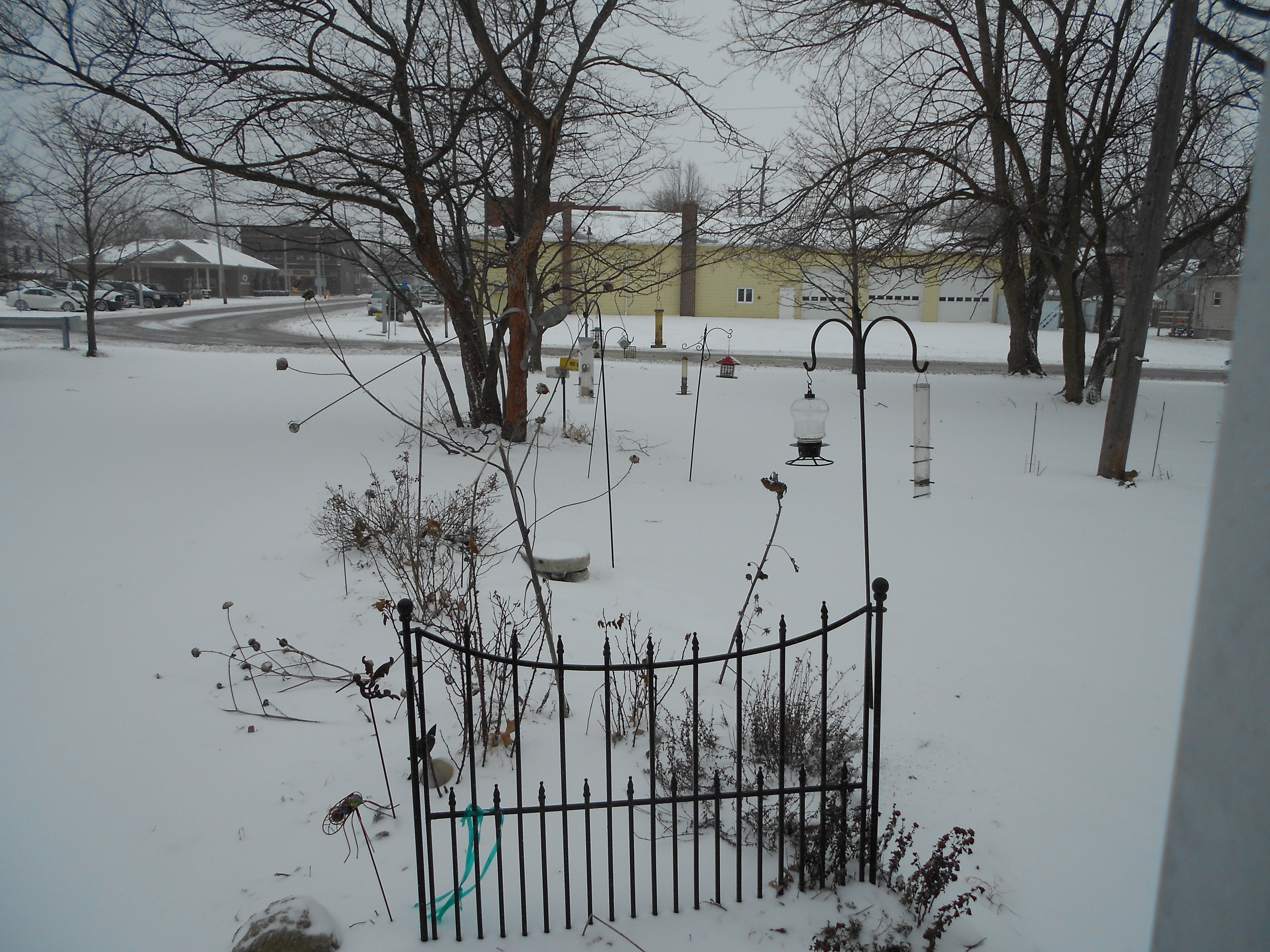
Stella Kirby sent in this photo for our Winter Interest.

winter interestt

Read Full Post »

« Newer Posts - Older Posts »