One of our Monroe County Master Gardener members sent this for the blog. Click below for a PDF file and Enjoy
Archive for the ‘Uncategorized’ Category
“If You Plant It, They Will Come”
Posted in Uncategorized on June 13, 2014| Leave a Comment »
Favorite things in the Extension garden by Karen Bender.
Posted in Uncategorized on June 8, 2014| Leave a Comment »
This time of year one of my favorite things is enjoying the beautiful fall colors. We are particularly blessed with a wonderful fall display at the Extension gardens. Many of the trees and shrubs are four season winners and it has been great to see these seasons in real specimens, not just photos in the garden catalogs. The gardens have also made it possible to continue planning for another favorite thing, watching birds in the winter.
While bird feeders brings the birds in, planting fruit and seed bearing shrubs and trees help sustain more birds (and other critters) as their preferred choice of food for many species. It has been a joy to monitor blue bird nesting activates through the summer but I hear their song throughout the winter and want to encourage them to stay around. The cornus group is used by many birds, including blue birds, because of its high fat content which helps sustain them through the winter. What a beautiful example of a Dogwood tree we have in the hummingbird garden! Cornus sericea, Redstemmed Dogwood, Gray Dogwood, Red-osier and Silky Dogwood are bird favorites and such beautiful berries for us to view & enjoy over the winter.
Another group of multi-seasonal interest is the Viburnum group. How can you beat spring flowers, fall colors and berries for the birds? One early spring I was surprised while on my deck to see a Cedar Wax Wing hop on the railing, give me a glance, dive into my Holly bush and emerge with a bright red holly berry, one of their favorite foods as they migrate further north in the spring. (Did you get a look at the Extension gardens’ Ilex? It’s a stunner! Last year I planted a Serviceberry and a Black Chokeberry. I am hoping they will add variety to yard banquet landscape plan. This year has been amazing abundance for most Malus species groups. While it may appear that the crab apples are not being used as they hang on but after several freezes, the tart flavor becomes more palatable to our flying friends. I continued to watch my tree through the winter and thought that was the wrong variety of flowering crab but by the spring, Robins were a frequent visitor and soon the tree was empty.
Julie Zickefoose, a writer and nature artist, has explained that sometimes the only sustaining food left near the early spring is Sumac. If you have a spot in your plan for Sumac, wild grape, Virginia Creeper, Poison Ivy (only in a remote area), Pokeberry and other native fruit bearers, you will be helping to sustain many species of birds . Don’t forget leaving out squash seeds and fruit seeds like apple and unused table grapes.
For more information, here are a few good books to consult:
Complete Guide to Bird Feeding, John Dennis
Wild about Birds, Carrol Henderson
Bring in the Birds, George Adams
Tool to help you out!
Posted in Uncategorized on April 14, 2014| 2 Comments »
Remember when Naida brought her favorite tool last year to a meeting? Well she sent me this information in case you may want to get one:
Last year when I brought my 36 volt B & D cordless
trimmer/edger to extension for a show & tell everyone really loved it
and I answered a number of questions about it. I was just going through
Sunday’s papers today and noticed the same trimmer in Menard’s sale
paper (the three closest Menards are in
Toledo, Livonia and Jackson). I have never seen it listed anywhere so cheaply
and would love to get the word out to our M.G. group. Two years ago I
paid $179 for mine and Menards has it for sale now and until April 20
for $129. You also get a $10 mail in rebate which brings the price down
to $119. This trimmer is one of the best garden tools I have ever
purchased. No electric cord to drag around and no pull-start gasoline
engine which is a pain to get started. Just snap the battery in and go!
I would recommend purchasing a second battery but check the price at
Amazon.com before purchasing at Menards.
B&D Cordless 13″ Trimmer/Edger – 36 volt Lithium battery
– Power command dial to choose between max power and max runtime
– Automatic Feed Spool
– Easily converts from trimmer to edger
– Includes spool, 36 volt battery and charger
Labels
Posted in Uncategorized on April 3, 2014| Leave a Comment »

This past winter was a great one for testing the durability of my plant
label. Last summer I used the Brother P-touch to make labels to be used
inside and out. Mine are printed on clear tape but you can purchase
different colored ones. The granola jar label, which has been through the
dishwasher a few times, is not peeling off. Now I hope my plants did as
well as my indoor labels and that I remember their correct names for more signs.
Sandy O’Connell
They’re on Their Way!
Posted in Uncategorized on March 27, 2014| 1 Comment »
One of our Advanced Master Gardeners sent this article to post:

courtesy of http://www.hummingbirds.net/map.html
As of Wednesday, March 26, migrating hummingbirds have moved into lower Tennessee and into North Carolina. You can follow their progress on this website: http://www.hummingbirds.net/map.html.
For our area, the rule of thumb is to put out feeders on Tax Day and remove them on Halloween. The last hummingbird I saw was on Oct 1, 2013, but I kept the feeders up until Oct. 31.
Remember to use a 4:1 ratio of water to sugar: Add ¼ cup white sugar to 1 cup of boiling water and allow the nectar solution to cool before filling the feeders. Any leftover solution can be refrigerated for up to a week, but try to change the solution in the feeders every few days.
DO NOT add food coloring or dye to the solution! Studies have shown that food coloring can be detrimental to the hummingbirds.
Providing this food for them as they migrate through entices them to stick around until they can supplement their food source with nectar from Cardinal Flower, Columbine, Coral Bells, Guara, Liatris, Rose of Sharon, Zinnia, and many other flowers.
Posting a Question:
Posted in Uncategorized on March 11, 2014| 1 Comment »
By Winnie Webb
What do you do when you hold a class and the people the class was designed for do not attend?
The Basic Home and Community Gardening class was held at the city of Monroe recreation department on January 10,2014. Bob Bransky, the garden liason for the community gardens at Munson Park in Monroe, was very well prepared with a great power point. He intended to cover the many facets needed to plan, plant, and maintaining a home garden. He also brought several various sized containers demonstrating composting and some interesting handouts. The next portion of the program was planned around community gardening, specifically to the Munson Park plots. This garden off of North Custer road has access to running water now. Plots are rented out by the season for a nominal fee. There is a storage shed on the property and there are informal day events planned to help with plot prep, planting and harvesting. This would be a great way for someone who had very little or no gardening space to not only raise home grown food but meet some interesting new friends. Another idea would be for someone who wanted to raise a large amount of tomatoes, beans, or cucumbers for canning or freezing and didn’t have space. Information on renting plots can be had by calling the City of Monroe Park and Recreation manager Loretta LaPointe at 734 384 9156 orwww.monroemi.gov.
To answer the question posed by the article title “What do you do when people don’t show up for a class: be flexible and share information! The attendees were Mr. Branskys friend Lisa, Loretta Lapointe, Michelle Buberniak and myself. So we weren’t exactly new gardeners! What we did find out was that Bob was active now in Wayne County MG programs because that’s where he took classes a few years ago when our local MSUE MG program did not offer classes. He actually thought there was no master gardener program in Monroe and that the Extension office was closed. How happy was I to inform him differently! Then I invited him and Lisa to start attending our meetings and functions. We were also able to tell him and Ms LaPointe of various other community gardens and planted areas around the county that we knew of that they had no previous knowledge. Programs at the Bedford Library, Arthur Leslow Community Center raised garden beds, Extension display gardens and several others. In turn, they shared with us the ideas the city has to create garden areas in various city parks for the public which may very well add to opportunities for master gardeners to teach and assist others and gain volunteer or education hours in the future. We had a great time that night turning what could have been a “disappointing turnout” into a wonderful opportunity to meet these new friends, network, and share interesting ideas and information. The following Saturday at the Bonsai class held at Flower Market, Bob and Lisa attended and met more local master gardeners and hopefully will continue to be a part of us for years to come. Every opportunity is an invitation for a positive outcome.
Book Reviews by Michele Buberniak
Posted in Uncategorized on February 27, 2014| 4 Comments »
The Sugar Maker’s Companion: An Integrated Approach to Producing Syrup from Maple Birch and Walnut Trees by Michael Farrell 2013
Don’t let the long title of this book discourage you from taking a look at the amazing material inside. The front cover draws you in with a photo of trees in a snowy landscape with sap buckets attached, this shares the space with a shot of glowing translucent jars of syrup, topped by a trio of desserts decorated with a pastry maple leaf ! The author, Michael Farrell states that this book is written primarily for those interested in actual syrup production and those doing it for a hobby might prefer a more concise guide. If you want to start production, be sure to read one of the first chapters , “Is Sugaring for You?”. Others chapters are devoted to topics such as sugarhouse design and construction , gathering techniques, marketing , etc. One that may be of special interest is Chapter 4, entitled, “An Untapped Resource.. Sap Producing Trees of North America “ this is where the reader may be surprised to learn that a wide variety of maples, as well as black walnut trees produce sap !
Even if you are not interested in “making sugar” any gardener or landowner will enjoy the abundance of photographs , the detailed directions , the trivia and other information including the locations of syrup companies located in Michigan and Ohio .
The author, Michael Farrell is on the staff at Cornell University He currently serves as Director of the Uihlein Forest- Cornell`s Sugar Maple Research & Extension Field Station in Lake Placid, NY .
A Class in Bonsai
Posted in Uncategorized on February 16, 2014| 1 Comment »
There’s a shop on the outskirts of Monroe, just south of Dundee called the Flower Market. As you walk past the door you encounter a large display of fairy garden accessories and a Koi pond filled with mouth open Koi hoping you have a morsel for them. Then there they are; the more than 900 bonsai plants and trees. Some are for sale, some are the owners collection. The owner, Kurt Smith, is about to give our Monroe County Master Gardeners a class on Bonsai. He shows us one from the collection not for sale that is over 40 years old as well as a Chinese Elm.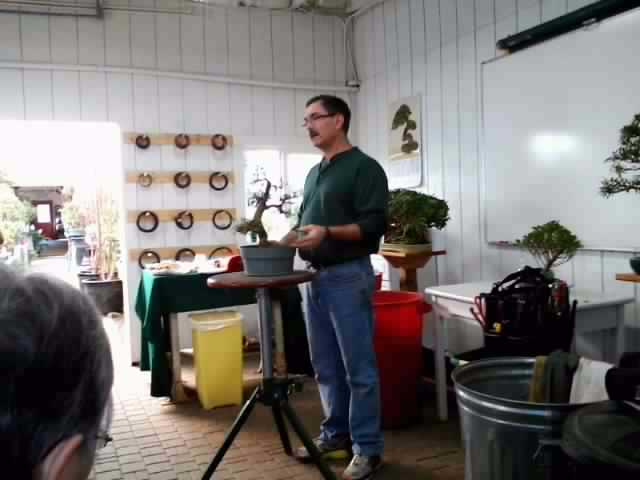

Here are notes from the class:
There are two classes of Bonsai. The Tropical, which you see in the Greenhouse, and the outdoor type. These outdoor plants must be outside and go through the seasonal changes including winter. If you plan to keep the Bonsai in the house choose an East or North window. A southern or west window are fine, but will dry out the plant fast and chances are you will probably miss watering it. It then will die. If you wish you can grow them under lights. Plants generally are smaller when grown in that fashion.
Bonsai need two key elements: Light and Water. The good bright light of that east or northern exposure and water when the soil is dry. Kurt suggests that you do not use moss or decorative rock over the dirt and roots entirely. If you cover the soil, you are unable to see when it is dry. You sight is your best indicator…look at the dish and ask…does this need water today? The color of the soil when wet is dark and rich, but is light and ashy when dry. The soil mix that he uses is equal parts of turfas, haydite and peat moss. If the plant needs water, soak it thoroughly. His soil mixture allows the roots to grow and get oxygen.
You may fertilize the plant once a week. Using a liquid fertilizer is best. The soil mixture used has no nutrient value so fertilizing is necessary for the growth. Kurt warns us though…do not fertilize a sick plant.
To begin you start with a bigger tree and then cut it down. You choose a plant where the trunk has movement. The upper section will be cut off and new limbs will grow. He shows us a ficus with a woody trunk and tells us to look for the area where the tree embraces you. That will be the front. Now, with a gasp from the crowd, he begins to take of all the leaves.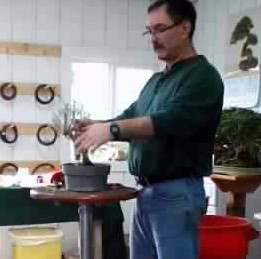
After removing all the leaves you take a look at it. find the first branch to begin with at the bottom approximately one third the way up the trunk. Now you begin to trum taking away unwanted branches. Try to alter the limbs and open up the trunk.
The next step is to wire copper colored aluminum around the branches and pull them into shape with out breaking them off. Thin the branches at the top for you only want one good branch at the top. When wiring try not to wire too tightly nor cross wires. After forming the tree take it from the pot and begin to remove the dirt from the root. He also suggests that you make sure the root doesn’t show the formation of the round pot on the top.
Trim away unnecessary roots so it will fit in your selected bonsai container. All containers should have holes for drainage. If holes are large add a screen over them. Kurt also strung a string thru the holes to tie in the tree. This helps to secure the tree until it take hold. He then continues to look at it, wire it and form it. He said to visualize a triangle. Any portion of a limb that sticks out from that triangle should be cut off. Kurt uses chop sticks to help work the soil around the plants root. Now water right away by submerging it until the bubbles stop… maybe a minute. Be careful not to over water. 
The Monroe County Master Gardeners received a great lesson. When you start your…send a photo for the blog to post. We’d love to share our gardeners education being put to use. Thank you Kurt for the very entertaining presentation.
Spring Alive at the Toledo Zoo
Posted in Uncategorized on February 13, 2014| Leave a Comment »
The Toledo Zoo is presenting a new event fun for the whole family:
The Toledo Zoo is presenting a new event fun for the whole family:
Spring Alive………..Fairytales, Fables & Flowers
February 27th through March 2nd
Fun blooms at this floral extravaganza featuring beloved childhood stories, family-friendly activities, animal encounters and more….
Some of the events include:
mini-workshops on fairy gardens, bonsai gardening, flower arranging and more
personal tours of the Zoo’s historic Conservatory
marketplace of experts’ favorite gardening tools
cooking demonstrations with the Zoo’s executive chef
plants and pollinators planting activity
Madcap Puppets present Aladdin & Friends
ice carving demonstrations
wine tasting
meet an animal
For more information on events listed by day and time visit: http://www.toledozoo.org/springalive
Great Growing Workshop
Posted in Uncategorized on February 7, 2014| 1 Comment »
Jennie sent this to me as an event that some may want to attend. Open the link on the last line for Registration and other information
Greetings gardener and those who’d like to grow and eat fresh, nutritious vegetables,
The Alpine Master Gardeners is hosting a “Get Growing” workshop and luncheon on Saturday, March 15, 2014 from 9 a.m. – 3 p.m. in Gaylord.
See brochure/registration and flyer attached. Please help us spread the word.
Informative and fun event
Open to the public
Early bird registration is $25 through March 5. Regular registration is $35
(Low rate due to great community sponsors-below)
Excellent opportunity for first time gardeners as well as people who have been gardening their whole lives.
We believe everyone will benefit from the event tailored to growing healthy, nutritious vegetables in a northern Michigan climate.
Featured speaker, Craig Schaaf, of Golden Rule Farms, will present “Secrets to Nurturing Vegetables For an Abundant Harvest”.
His small garden has steadily grown, now capable of providing beyond his family’s financial needs.
Craig raises quality vegetables for a restaurant in Traverse City
Enjoys experimentation, and loves to teach.
Learn how to increase harvest
Gain great enjoyment from your garden.
Soil enrichment, proper tilling techniques, weed and pest control, crop rotation ……
Bring your questions on any gardening topic – season extension/seed saving …….
Lunch at the event will be a locally grown feast prepared by chef and farmer Mike Everts of “Real Food Dream Kitchens” and Blackbird Gardens of Petoskey. Blackbird Gardens has been an integrated culinary garden with clean-grown vegetables, and fine catering company for more than 25 years.
Morning fruit/yogurt/granola parfaits * spinach salad with walnuts/beets/feta & maple/Dijon/balsamic dressing * bison red chili * curried lentil squash soup * roasted root vegetables * Breadworks Bread and Baba Gahnou * delicious local food dessert.
The presenting sponsor of the event is Otsego Wildlife Legacy Society (OWLS).
Other sponsors are Treetops & Home Depot, as well as Family Farm Home, 5/3 Bank, Otsego Memorial Hospital and Meijer.
Online brochure and one page registration forms are available at http://www.otsego.org/amg (under Events).
For more information, contact Jeanne Freymuth at 988-732-5348
or email alpinemastergardeners@gmail.com.
Alpine Master Gardener Association is a group of Master Gardeners whose mission is to assist in the education of the public to the positive benefits of gardening.
PLEASE HELP US BRING THIS QUALITY PROGRAM AND LUNCHEON TO NORTHERN MICHIGAN BY SPREADING THE WORD.
Thank you.
“Get Growing” Workshop and Luncheon Committee
Alpine Master Gardeners Association (AMGA)
 Monroe County Master Gardener Association