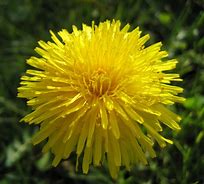
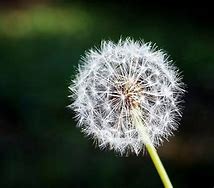
It’s very photogenic , in yellow, or as a white sphere of seeds. Yet, so many despise this weed, which is sometimes called an herb. All God’s flowers have their purpose. I recently came across a video on this little beauty. It was very insightful. Here are some things we should learn so we can again love the dandelion.
Most of us are aware that this is one of the first sources of pollen for the bees. That alone is a great reason to love this plant. But there are other reasons as well. So here are a few things that surprised me….and yes, I’ve pulled a few since, but I’ve also left a few. The decision of which ones to pull and leave depended on the area where it was growing.
So the first surprise I learned, dandelions typically grow where the soil is compact. That’s why they appear all along those edges of my sidewalk. and in my pathways. Their purposes is to help break that soil up and de-compact it. I suppose pulling them may also loosen the soil, but we can just let them do their job.
The second fact I learned, was that that root can go down as far as 15 feet. Why would it reach so far? Well, dandelions also grow where there is a lack of calcium in the soil. These roots reach down till it find the source and bring that calcium up into the leaves. These leaves then decompose and release that calcium into your lawn or garden.
Dandelions are encouraged by acidic soils as well. They also will grow where you grass doesn’t, even in shade.
We all know that it’s edible. But here are a few interesting things I didn’t realize. First it’s a natural diuretic, helping the kidneys clear out waste, salt, and excess water. They do this by causing more frequent urination. This helps with blood pressure as well.
It will promote digestion as well. Used as a mild laxative, as well as increasing stomach acid to aid digestion especially of fats. By increasing bile, it helps to protect from gall bladder problems. It also helps to detoxify the liver. Plus so many more benefits.
The leaves are a rich source of beta-carotene which we convert into vitamin A. This flowering plant is also rich in vitamin C, fiber, potassium, iron, calcium, magnesium, zinc, and phosphorus. There’s just too many good things about this plant. So go on the net…do a bit of searching…find a fact and share it.
It’s best you harvest the leaves early, since once the flower begins to produce seed it becomes bitter to taste. I knew that this plant was used in wine, yet never understood why anyone would bother. My knowledge has been enlightened by this little yellow flower that pops up where you least want it. OK, I’m leaving the majority and going to try some green in a salad.
For Photo Friday, let’s contribute our photos of our dandelion production in are yards…..send them to my email. I can contribute as well.
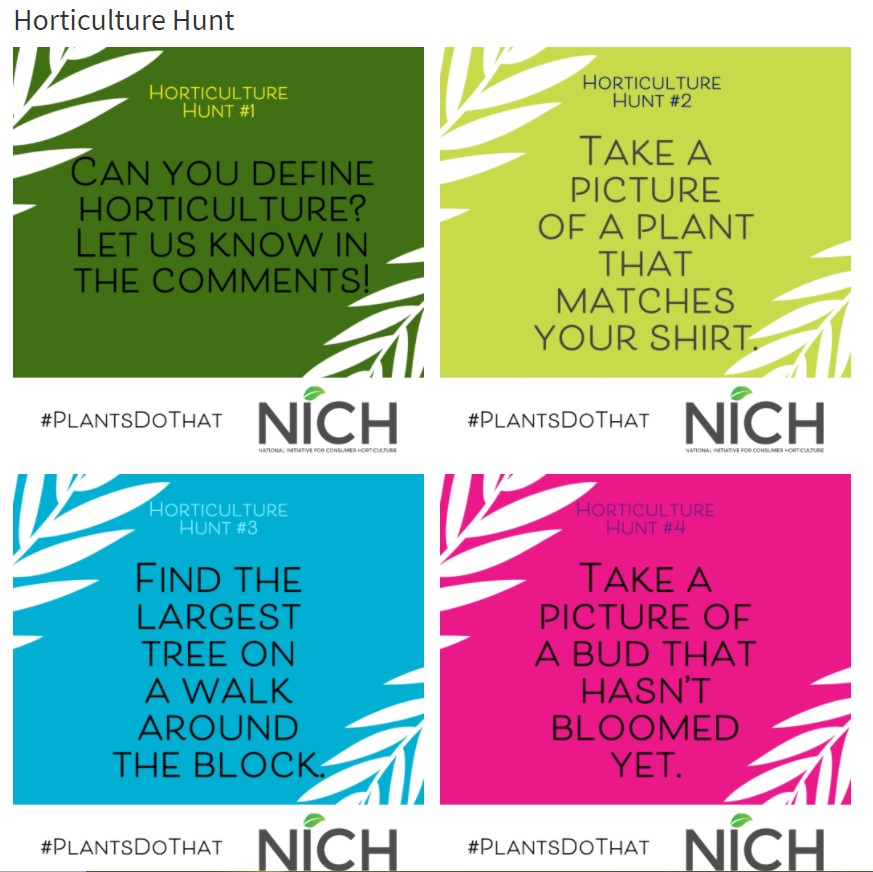
Jennie sent in this. The MMGA had this posted on Facebook. Below is a graphic of just a few items. Click on the link enclosed in the next paragraph and see the full hunt.
Are you aware of The National Initiative for Consumer Horticulture (NICH)? The Michigan Master Gardener Association posted this activity on Facebook from the NICH website, https://consumerhort.org/horticulture-hunt/ which looks like a fun thing for friends to do together outdoors, especially if one is a younger friend. The NICH website has a number of resources to investigate.
NCIH is described as “a consortium of industry leaders who are promoting the benefits and value of horticulture. NICH brings together academia, government, industry, and nonprofits to cultivate the growth and development of a healthy world through landscapes, gardens and plants — indoors and out.” It sounds like a modern update to the National Garden Bureau.
Changing EAB rules, oak wilt, invasive species management, and more! This spring’s EABU webinar series will cover a wide range of topics and see the start of a new series of 30-min All You Need to Know videos! Join us Thursdays at 11:00 AM ET starting March 18th. Details below!
All webinars will be recorded. You can sign up to watch the live webinars or be notified when the recordings are posted by clicking on the links below for each of the sessions. Please feel free to share this announcement with anyone you think might be interested! All sessions are virtual and brought to you at no cost, as a result of continued support from the USDA Forest Service.
CEUs will be available (CCH, ISA, SAF…) for the live webinar! Contact barne175@purdue.edu for more details.
Abstract: This webinar will cover the recent federal domestic deregulation of emerald ash borer (EAB). Herb Bolton will discuss what regulatory actions the USDA Animal and Plant Health Inspection Service (APHIS) has ended since deregulation, and the continuation of the APHIS EAB program for biological control, EAB IPM and biological control research, and communication and outreach to the public on firewood. Ben Slager will give an overview of the APHIS EAB biological control program, the status of the program nationally, and how states and other partners can get involved in the release and recovery of the EAB parasitoids.
Title: The economics of area-wide ash surveillance, treatment, and removal strategies to slow the spread of emerald ash borer in urban forests
Speaker: Robert G. Haight, USDA Forest Service, Northern Research Station, St. Paul, MN
Abstract: The emerald ash borer (EAB) is one of the most economically and environmentally damaging invasive species ever to reach the United States. Economic damage of EAB is most severe in cities that lose abundant high-value ash trees growing along streets and in yards. Pest management and economic models suggest that an area-wide approach across all ownerships, including surveillance for early detection, treatment of ash trees with systemic insecticides, and removal of infested ash trees, yields the greatest benefits at the lowest costs. In this talk, Bob Haight will present research on the economics of area-wide strategies in Minneapolis/Saint Paul metropolitan region, the city of Winnipeg, Manitoba, and the state of New Jersey. The key findings for resource managers are:
Surveillance for early detection of infested trees pays off. Waiting to apply surveillance and management risks the buildup of the EAB population causing more damage and economic loss.
Once surveillance identifies infested trees, cost-effective actions include treating newly infested trees and removing highly infested trees. If the budget is limited, treating newly infested trees is the priority.
For risk averse managers who want to minimize the risk of overwhelming ash mortality, the cost-effective strategy is to monitor and remove ash trees in the vicinity of infestations.
Cooperation among city governments and private landowners can increase benefits for all.
Title: MTE Oak Wilt Management and Control Speaker: Tommy Stueck III, Forest Health Forester, Menominee Tribal Enterprises Date: April 8th, 11:00 AM ET Registration: https://msu.zoom.us/webinar/register/WN_jPkVS9tmSnmko9ZEdhNt1A Abstract: Oak wilt is a deadly disease of oaks found throughout the Midwest and into the South. The speaker will cover: Northern Pin Oak Management vs Northern Red Oak Management, Surveying Techniques, Pocket Marking Technique, Oak Wilt ID, Bruhn’s Root Graft Model, Types of Treatments, and Success Rates.
Title: Detecting and Monitoring Invasive and Non-Native Species from NEON Pitfall Traps Speaker: Michael D. Weiser, University of Oklahoma Date: April 22nd, 11:00 AM ET Registration:https://msu.zoom.us/webinar/register/WN_xEFAr6N0TQilRa5NToHDmQ Abstract: NEON (the National Ecological Observatory Network) uses pitfall traps to collect ground beetles (Carabidae) at 47 sites across the continental USA, Hawaii, Alaska, and Puerto Rico. NEON technicians remove these beetles and retain all other pitfall organisms as “Invertebrate Bycatch.” Using a combination of next-generation metagenomic sequencing and high-resolution digital imaging we have developed processes to non-destructively sample and identify taxa from the ethanol storage media. We are able to use these data to detect and monitor range expansions in some non-native species.
Title: Gypsy moth: Everything you need to know in half an hour Speaker: Cliff Sadof, Elizabeth Barnes of Purdue University, Department of Entomology, and Carrie Tauscher of Indiana Department of Natural Resources, Division of Forestry Date: April 28th, 11:00 AM ET Registration: https://msu.zoom.us/webinar/register/WN_EjBdXKugQWOZil8Ws23U5A Abstract: When does gypsy moth kill trees? When don’t you have to worry? Learn the latest in key information about gypsy moth including: management, current distribution, preventing spread, basic biology, host-plant identification, and more!
Title: Spotted lanternfly: Everything you need to know in half an hour Speaker: Cliff Sadof, Elizabeth Barnes of Purdue University, Department of Entomology, and Carrie Tauscher of Indiana Department of Natural Resources, Division of Forestry Date: April 29th, 11:00 AM ET Registration: https://msu.zoom.us/webinar/register/WN_Xa1oJU34QkSl3TNr-cmQOg Abstract: Spotted lanternfly is a destructive pest that impacts over 70 species of plants. Learn the latest information about this pest including: current distribution, management, monitoring, basic biology, host-plant identification, and more!
Title: Emerald ash borer: Everything you need to know in half an hour Speaker: Cliff Sadof, Elizabeth Barnes of Purdue University, Department of Entomology, and Carrie Tauscher of Indiana Department of Natural Resources, Division of Forestry Date: May 5th, 11:00 AM ET Registration: Coming soon Abstract: Emerald ash borer is widespread across the Midwest but ash trees can be protected from it. Once those trees die, they become extremely dangerous. Learn the latest information on: management, managing EAB-killed trees, biocontrol programs, basic biology, host-plant identification, and more!
Title: Asian longhorned beetle: Everything you need to know in half an hour Speaker: Cliff Sadof, Elizabeth Barnes of Purdue University, Department of Entomology, and Carrie Tauscher of Indiana Department of Natural Resources, Division of Forestry Date: May 6th, 11:00 AM ET Registration: Coming soon Abstract: Asian longhorned beetle is a death sentence to the trees it infests. Learn the latest on: current distribution, monitoring, basic biology, host-plant identification, and more!
Title: Thousand cankers disease: Everything you need to know in half an hour Speaker: Cliff Sadof, Elizabeth Barnes of Purdue University, Department of Entomology, and Carrie Tauscher of Indiana Department of Natural Resources, Division of Forestry Date: May 12th, 11:00 AM ET Registration: Coming soon Abstract: Should you be concerned about this disease of walnut trees? Learn the latest about thousand cankers disease including: distribution, management, monitoring, basic biology, host-plant identification, and more!
Title: Hemlock woolly adelgid: Everything you need to know in half an hour Speaker: Cliff Sadof, Elizabeth Barnes of Purdue University, Department of Entomology, and Carrie Tauscher of Indiana Department of Natural Resources, Division of Forestry Date: May 13th, 11:00 AM ET Registration: Coming soon Abstract: Hemlock woolly adelgid (HWA) is a deadly pest of hemlock trees. Learn the latest about HWA: current distribution, biocontrol programs, management, monitoring, basic biology, host-plant identification, and more!
Growing Degree Days (GDD) are a measurement of the growth and development of plants and insects during the growing season. Development does not occur at this time unless the temperature is above a minimum threshold value, or what is also referred to as the base temperature. This base temperature can vary for different organisms and is determined through research and experimentation.
The actual temperature experienced by an organism is influenced by several factors and these factors will ultimately affect that organisms growth and development. We can probably all agree that depending on the weather, an organism’s temperature may be a few degrees more or less than that recorded. For example, an organism in direct sunlight will likely experience higher temperatures, than those in full shade, and of course somewhere in the middle if the organism is located in dabbled shade, or both sun and shade at some point throughout the day. What is comes down to is the actual location can result in those temperature differences.
Fertility and nutrient levels in the soil can also affect the growth rate of insects and plants. The presence of weeds and precipitation may indirectly influence development as well. Due to these factors and some other scientific considerations, a base temperature of 50 degrees Fahrenheit is considered acceptable for all plants and insects, and what is used on the Ohio website.
GDD is a tool that should be in each green industry professional’s “tool-box”, and can be beneficial for consumers too. In Ohio, we are very lucky to have a GDD website that was developed as a result of work that Daniel Herms, Denise Ellsworth, Ashley Kulhanek and other contributors including Ohio Master Gardener Volunteers over the years. Check out the website for more information: https://www.oardc.ohio-state.edu/gdd/
The website uses GDD that ultimately provides a biological calendar that ‘marries’ a list of plants at their first and full bloom, and insect activity. This calendar is a sequence of events that includes both plants and insects and ties to each organisms to the GDD.
It is important to say that while the actual number associated with GDD is based on weather stations across Ohio, there can be some differences based on microclimates, but the sequence of activity is always in the same order. As you use GDD, it is always recommended to get outdoors and compare what the website is telling you what should be happening, and what you are seeing. For example, the first plant on the Ohio list is first bloom of silver maple at 34 GDD. Check out the website, type in your Ohio zip code, see what the website says your GDD is, and then head out to the field and make the seasonal observations that is included in the list. Are you seeing silver maples blooming in your area?
Where trade names are used, no discrimination is intended and no endorsement by Ohio State University Extension is implied. Although every attempt is made to produce information that is complete, timely, and accurate, the pesticide user bears responsibility of consulting the pesticide label and adhering to those directions.
Ohio State University Extension embraces human diversity and is committed to ensuring that all research and related educational programs are available to clientele on a nondiscriminatory basis without regard to race, color, religion, sex, age, national origin, sexual orientation, gender identity or expression, disability, or veteran status. This statement is in accordance with United States Civil Rights Laws and the USDA.
CFAES provides research and related educational programs to clientele on a nondiscriminatory basis. For more information: [ http://go.osu.edu/cfaesdiversity ].
Any materials in this newsletter may be reproduced for educational purposes providing the source is credited.









 Monroe County Master Gardener Association